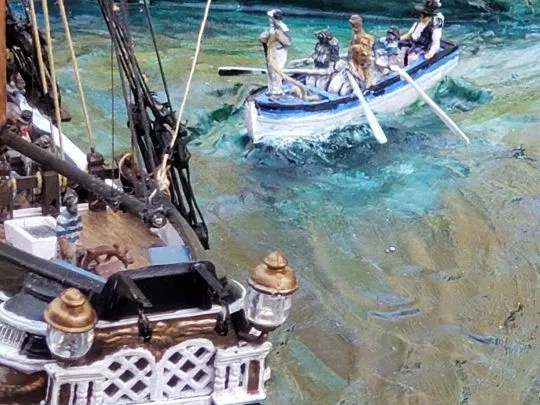
Falcon plastic model pirate ship into something that was realistically scaled to both itself and other ships in her size. That was truly the intent.
Sadly, things got out of hand…
The Why
The entire adventure began with the goal to replace the grossly mis-scaled mainmast top. Wood seemed to be the obvious medium, as masts were, well, wood.
But sticking a correctly scaled wooden mast into that plastic planter box of a fixture seemed like a sin. So, out went the plastic decks, to be replaced with coffee stir sticks.
To facilitate the depth of the stir sticks, it became clear that the lower hull would have to go. My limited engineering skills and degree of patience couldn’t cope with the lovely, albeit shallow, slope of her bottom.
And that, dear friend, is how the Black Falcon came to be adrift in a wide wide wide wide sea.
The What
But, of what should the sea be made? Many modelers make their oceans out of colored resin, with white foamy waves and everything, and the results are breathtaking. But that takes planning, and patience, and chemicals I prefer not to inhale.
My brother is a model railroader from way back, and I, too, followed those rails for a time. Old habits die hard, and that made plaster the go-to medium.
Black Falcon sits on a flat piece of wood, bordered by strips of linoleum floor sample. As life is never simple, a piece of wood the appropriate size wasn’t available, so the flat piece is in fact three pieces of leftover picket fence pickets, screwed to another two pieces to keep them in place. The castoff linoleum hides the ugliness below. Trust me, it’s there.
Plaster of Paris is an aggravating substance. This is a known fact.
It’s liquid and watery for awhile, but turn your back to, say, do the dishes, and suddenly it’s solid like last week’s cheese. That I have no patience is, I believe, an established fact. I didn’t get along well with the Parisian substance.
Before it hardened completely, I shoved the Black Falcon in it to give her a place to sit in the plaster sea. While I provided the same service for the boat, the Black Falcon became hardened in place. Ack!
I used my fingers to add some wave troughs, but wasn’t terribly successful.
The Color
From Huazhuang, in Jiangsu Province, came a very nice, very inexpensive set of acrylic paints, packaged in tubes. Despite the $10 price tag from Amazon, they’re really a nice product. Much of the Black Falcon wears them proudly.
Because they’re in a tube, I thought I would be clever and smear some onto a paper plate, add some water, and then let the colors mix on the plaster sea.
Mistake.
Another thing about yeso de Paris is that it’s incredibly thirsty. There aint no mixing colors on the plaster. Instead, I got deep, dark pools of color, straight into plaster.
In plan B, I mixed the colors on the paper plate, and then brushed the mixture onto the plaster. I would have been easier had there not been a ship in the middle, but such is the price of impatience.
The challenge lay in brushing on the colors in one direction. The plaster gleefully soaked up whatever it could get, and holidays were so common it looked like August in Paris. You know, Europeans all go on holiday in August, and this is plaster of Paris…
As one color soaked in, another, lighter shade went on. The rule is to start with light colors first, but having the lighter shades on top seemed to make the color variation more subtle.
Sadly, there was just no way around the deep color holes I had made.
That’s when it seemed obvious that the Black Falcon lay in shallower water. Look, down there, do you see those shadows? Perhaps a rock, or a cavern, or some coral? Perhaps a kelp forest.
Raw titanium white is pushed right up against the hull. As I hadn’t finished detailing the hull before I stuck her into the sea, there are a number of crudities in her that wish had been fixed that now bear a splash of white that truly doesn’t help. Getting a skinny brush up under the boat’s oars was no picnic, either.
The white is brushed on the crests of the waves, such as they are, but feathered into the colors below so that it doesn’t show. I believe that’s called wasted effort…
The Shine
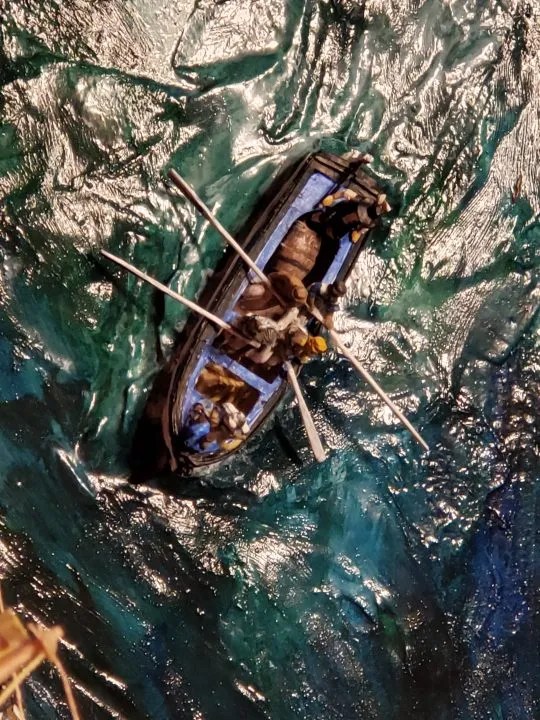
What is the surface of the sea if not reflective? In the case of a plaster ocean, it’s reflective with some fingerprints!
The original plan was to use Modge Podge, because it sets up quickly and dries clear. But, it’s not as clear as you’d think, and looks kind of flat in another harbor diorama. The smell is dreadful, the stuff is gross to work with, and doesn’t shine much. Out.
The surface of the Black Falcon’s sea is spar varnish. Fitting, eh mate? Spar varnish be the shiny stuff, do ye ken?
According to the instructions on the can, you’re supposed to lay down a coat, wait until it dries, sand it, and then lay down another. And that’s a great idea for those with patience and who work with a surface than can be sanded. As I had neither, I rather slopped on three or four coats just as soon as the previous coat seemed dry enough.
The extra coats gave a little depth, and blended the various colors together.
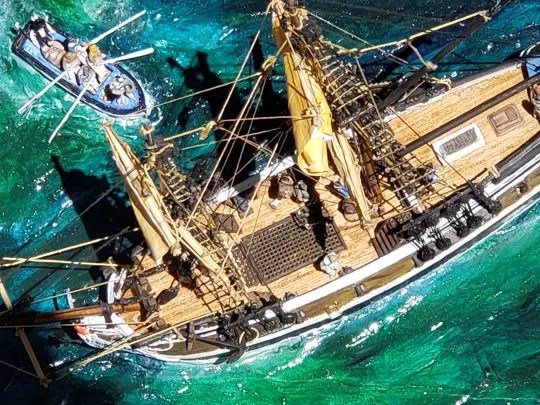
And so, what began as the modest ambition of replacing a mast top became, in the fullness of time and the fullness of impatience, a ship adrift in a plaster sea on a base of fence pickets, sailing nowhere in particular but looking rather well doing it. The Black Falcon is not finished. She may never be finished. There are futtock shrouds yet to rig, mysteries yet to solve, and things foolishly omitted that will continue to haunt the occasional sleepless hour.
But she floats in her shallow tropical bay, her crew lounging on deck, her boat returning with a keg of whatever that island stream had to offer, and her figurehead waving cheerfully at nothing in particular.
For a terrible modeler with no patience and a romantic’s eye, that will do nicely. That’ll do, ship. That’ll do.


 Tales of the Black Falcon
Leave a comment