Modern ships provide water for their crew by reclaiming used gray water. If that’s a new term to you, it’s easy: your sinks and shower produce gray water. Your toilet produces black water. No need to explain that further.
In the Black Falcon‘s day, not so much. Before she set sail on an ocean voyage, the ship’s purser, kind of the supplies manager, would purchase and have delivered massive kegs of drinking water. Well, sometimes they were massive, but other times the kegs might be the size of R2D2.

If the voyage was long, and sometimes a voyage could take many months, the water would run out. Or, more common, the water would turn green with algae, because water sanitation wasn’t a thing yet.
So, here would be a ship, thousands of miles from home, with no drinking water for the crew. They’ll go without food, but they won’t last without water.
The captain and the sailing master would pull out the charts and their experiences, and find an island, any island, that had a running stream on it. Even a spring would do.

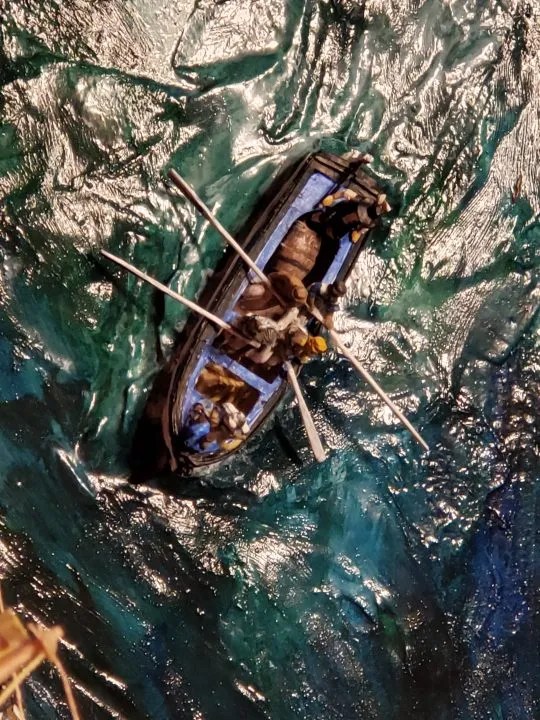
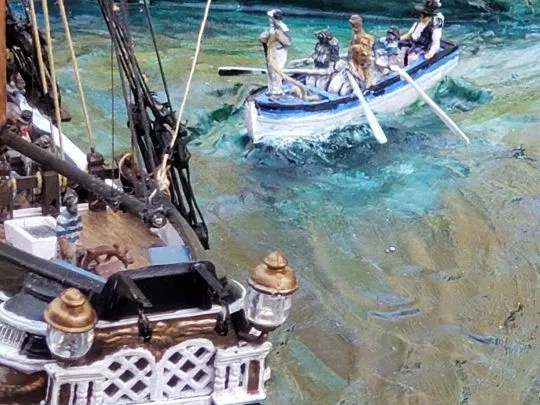
They’d sail for the island, drop anchor as close to shore as they dared, and off into the longboat would go the ship’s cooper, an officer, and a number of sailors. All carried muskets and cutlasses, because one never knows into whom one will run on a tropical island. Could be savages, could be buccaneers, or even Navy men!
The cooper would bring along a bundle of barrel staves and iron hoops. While the officer and sailors were off looking for the stream, the cooper and his mate would use those parts to assemble a water barrel.
They’d fill the barrel with water from the stream, lug it down to the boat, and row it out to the ship.
The ship’s carpenter usually went along, too. He was looking for wood pieces that might be useful in making repairs.
If the island was uninhabited, the crew might be allowed ashore for a bit of R&R. If there were natives, the crew was usually kept aboard: no sense inviting trouble.

Getting the full barrels of water back aboard ship could be a challenge. Of course they were now extremely heavy, and it was difficult to lift them up and over the ship’s side.

In one method, and long rope was run from the main deck up to the main yard, through a block at the yard arm, and then down into the boat. A sling on the end of the rope held the barrel, and the sailors pulled on the rope to hoist the barrel out of the boat while an old fellow squeaked out a shanty with a fiddle to help them maintain a rhythm. Once above the side rail, other sailors would turn the yard to set the keg over the deck, and the first sailors would lower away – easy, now, boys…

Another, and my favorite, method was called parbuckling. Yes, parbuckling. Two ropes were tied off on the main deck, and then fed down over the side, around the barrel in a loop, and then ran back up to the deck. Sailors pulled on the ropes, closing the loops. As they pulled in the ropes, the barrel rolled up the side of the ship. Brilliant.
So, just a closing thought, but most often that water that came aboard from your typical tropical isle would have been none too clean, what with fish farts, monkey doo, and all other manner of things having been dropped in it. But, drink it the sailors did, and never wondered why some mates would spend the next few days not feeling quite themselves.
Tales of the Black Falcon is part of the John D Reinhart content family. Writer, illustrator, videographer, and accidental filmmaker — find the whole story at JohnDReinhart.com.
©2026 John D Reinhart/TalesOfTheBlackFalcon.com – all rights reserved


 Tales of the Black Falcon
Leave a comment