On Watering, Briefly

A ship thousands of miles from home with no drinking water had two options: find an island or die of thirst. Here’s how they got the water aboard — and what was probably in it.

Modern ships provide water for their crew by reclaiming used gray water. If that’s a new term to you, it’s easy: your sinks and shower produce gray water. Your toilet produces black water. No need to explain that further.

In the Black Falcon‘s day, not so much. Before she set sail on an ocean voyage, the ship’s purser, kind of the supplies manager, would purchase and have delivered massive kegs of drinking water. Well, sometimes they were massive, but other times the kegs might be the size of R2D2.

If the voyage was long, and sometimes a voyage could take many months, the water would run out. Or, more common, the water would turn green with algae, because water sanitation wasn’t a thing yet.

So, here would be a ship, thousands of miles from home, with no drinking water for the crew. They’ll go without food, but they won’t last without water.

The captain and the sailing master would pull out the charts and their experiences, and find an island, any island, that had a running stream on it. Even a spring would do.

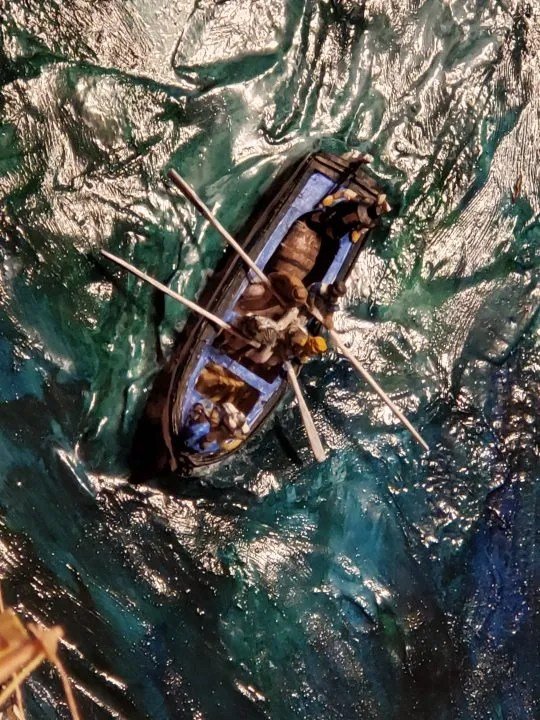
They’d sail for the island, drop anchor as close to shore as they dared, and off into the longboat would go the ship’s cooper, an officer, and a number of sailors. All carried muskets and cutlasses, because one never knows into whom one will run on a tropical island. Could be savages, could be buccaneers, or even Navy men!

The cooper would bring along a bundle of barrel staves and iron hoops. While the officer and sailors were off looking for the stream, the cooper and his mate would use those parts to assemble a water barrel.

They’d fill the barrel with water from the stream, lug it down to the boat, and row it out to the ship.

The ship’s carpenter usually went along, too. He was looking for wood pieces that might be useful in making repairs.

If the island was uninhabited, the crew might be allowed ashore for a bit of R&R. If there were natives, the crew was usually kept aboard: no sense inviting trouble.

Getting the full barrels of water back aboard ship could be a challenge. Of course they were now extremely heavy, and it was difficult to lift them up and over the ship’s side.

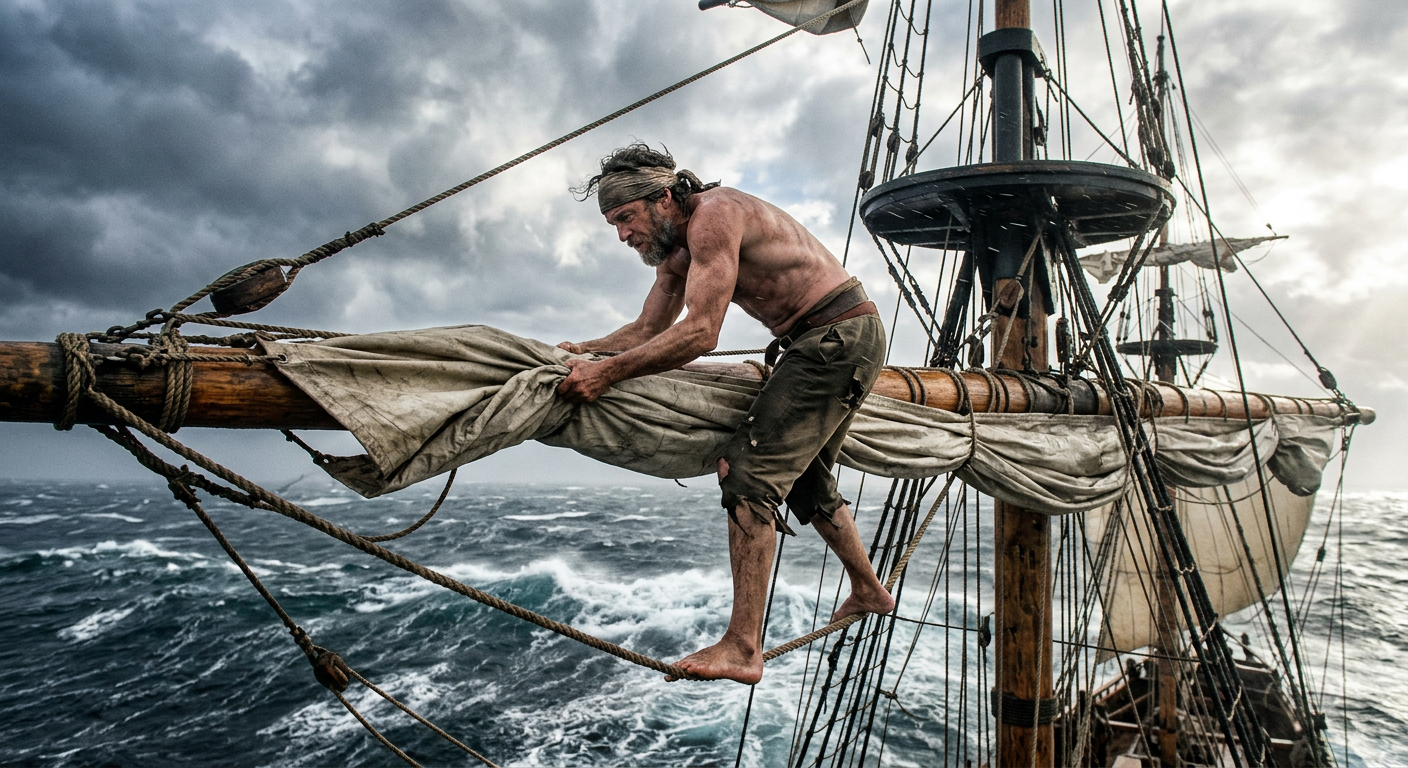
In one method, and long rope was run from the main deck up to the main yard, through a block at the yard arm, and then down into the boat. A sling on the end of the rope held the barrel, and the sailors pulled on the rope to hoist the barrel out of the boat while an old fellow squeaked out a shanty with a fiddle to help them maintain a rhythm. Once above the side rail, other sailors would turn the yard to set the keg over the deck, and the first sailors would lower away – easy, now, boys…

Another, and my favorite, method was called parbuckling. Yes, parbuckling. Two ropes were tied off on the main deck, and then fed down over the side, around the barrel in a loop, and then ran back up to the deck. Sailors pulled on the ropes, closing the loops. As they pulled in the ropes, the barrel rolled up the side of the ship. Brilliant.

So, just a closing thought, but most often that water that came aboard from your typical tropical isle would have been none too clean, what with fish farts, monkey doo, and all other manner of things having been dropped in it. But, drink it the sailors did, and never wondered why some mates would spend the next few days not feeling quite themselves.

Tales of the Black Falcon is part of the John D Reinhart content family. Writer, illustrator, videographer, and accidental filmmaker — find the whole story at JohnDReinhart.com.

©2026 John D Reinhart/TalesOfTheBlackFalcon.com – all rights reserved

Pirates and Yoda: An Unlikely Connection It Is

Yoda and pirates speak the same way. This is either a remarkable coincidence, proof of extraterrestrial influence in the Caribbean, or Lawrence Kasdan being very clever.

“Judge me by my size, do you?” – Yoda 
 
“Judge me by me size, do ye?” – Red Suarez, fictional pirate.


Eerie, isn’t it? Try this one: 
 
“The future I cannot see” – Yoda 
 
“The future I cannot see” – Cap’t Barbossa. 
 
Call me crazy, but I’m seeing a definite link between the syntactically challenged English Yoda speaks and the educationally challenged middle English spoken by fictional pirates. A link, a connection, a commonality. 
 
Try it. Take any Yoda line, swap out the word “you” with the word “ye”, and say it like Long John Silver. 
 
“Truly wonderful the mind of a child is.” 
 
Creepy, am I right? 
 
So? What gives?  I’ve come up with three theories: 
 
First theory: Yoda and pirates come from the same stock. One day those ghost hunting guys who keeps discovering Chupacabra tracks for cable television are going to uncover the remains of a Yoda-like creature that crash-landed in the Caribbean some 500 years ago. “Help me, you must,” cried the sole survivor. This theory is not very likely. 
 
Second theory: convoluted sentence structure is a byproduct of being strong with The Force. Yoda is certainly robust in that respect. And it’s not a long stretch to imagine pirates as being strong in the Dark Side. Still, Darth Vader didn’t talk like a pirate, and Kylo Ren uses pretty good grammar. Even Luke Skywalker, about whom Darth Vader said “The Force is strong in this one” – even he got subjects and verbs in the right order. Another not very likely theory. 
 
Third theory: Lawrence Kasdan, who wrote the screenplay for The Empire Strikes Back, needed to give Yoda a quirky-yet-charming mannerism that would make him sound both familiar and alien. Clever, this dialect choice was. This would be the most likely theory. 
 
Now, as I know you know, not all pirates talked like Yoda. Pirates mostly spoke in the dialect of their native lands – during the Golden Age of Piracy, this would have been England. And, since the greatest percentage of pirates were not men of culture and learning, they tended to use the rougher language of the streets – stab me in me vitals if that don’t be true! 
 
If you read Treasure Island, by Robert Louis Stevenson, you’ll get a great pirate caricature in Long John Silver. But read The Black Swan, by  Rafael Sabatini, and you’ll find a great mix of swashbuckling pirate and gentlemen of fortune that, while quite romantic, was probably equally accurate. 
 
And, middle English, which was in use at the close of the Elizabethan Era, quite at the same time as the Golden Age of Piracy, was full of fun, convoluted sentence structures. This one is my current favorite: “Avoid taverns, brothels and gambling halls should I, were I you.” 
 
Until the link between the citizens of Dagobah and Port Royal is defined, however, around Yoda my wallet should I watch. Arrgh.

Related Reads

Tales of the Black Falcon is part of the John D Reinhart content family. Writer, illustrator, videographer, and accidental filmmaker — find the whole story at JohnDReinhart.com.

©2026 John D Reinhart/TalesOfTheBlackFalcon.com – all rights reserved
Gentlemen of Fortune

The Disneyland song makes it sound appealing. It wasn’t. Once you turned pirate there was no going back — not to the sea, not to land, not to anything resembling a normal life.

Despite that Disneyland song that goes Yo Ho, Yo Ho, a pirate’s life would not be for most people.

A blue water sailor’s job during the Golden Age of Piracy, from around 1675 until 1715 or so, was not easy. Reefing sails, hauling braces, trimming yards – those things were massively physical tasks on the sunniest of calm days. Performing them in the teeth of a gale in the dead of night took almost superhuman resolve and tenacity.

That sailor’s life was a constant physical struggle. Things were forever damp, and his quarters were terribly cramped. Captains could be oppressive, creating what we now call a hostile work environment, with bullying and harassment and worse, the food was often bad, and with little to drink beyond rum and beer, you can see what would make a sailor’s life a misery.

Now, you would assume that your pirate, sea rover, gentleman of fortune, buccaneer, corsair, freebooter, call him what you like – a scallywag – would have had things better, wouldn’t you?

In truth, he had it worse.

All those dreadful realities that faced a common sailor were exactly the same for a common pirate. Oh, maybe the food was a little better, and the management a little less oppressive.

But the work of sailing a ship continues whether the hand on the rope belongs to a sailor or a pirate. The weather treats each with equal disdain, and the sea doesn’t care.

And once a man turns pirate, there is no going back. Wherever he goes in the world, he’s a pirate, and he can be hanged by any civilized navy.

Let’s say he goes home to visit his sister. A sailor in the pub recognizes him and tells the local magistrate. The soldiers show up and he’s marched off to jail, from there to be hanged. There’s no justice for a dirty pirate.

Let’s say he quits a’pirating, and instead becomes an honest sailorman. One day one of the crew recognizes him and tells his captain. The ship’s captain can hang him, too.

Let’s say he quits the sea – what is it he can do for a living? Beg? That happened often enough.

“I be an honest man, cap’n,” he tells the landowner. “Tending cows is what I did before I took to the sea, you understand.”

The merciful landowner hires him, and he lives in the barn and has regular, simple meals. But them folks at the pub start to whispering, and pretty soon the truth comes out and the noose goes around his neck.

Nope. Once he’s gone to the dark side, there be no turning back. That has to weigh on his soul. How could he have been so stupid?

Worse still, it was so easy to turn pirate. His own ship was taken by pirates, the crew subdued and cowed by nasty looking men with cutlasses and pistols.

“Who here will join us? Who here will take the free and easy course to riches?” says the pirate captain.

No more work aboard this barge, the sailor thinks. Goodbye, Captain Surly, and hello, freedom. Not a hard choice when you put it that way. He lowers his hands and joins the fellows with swords and guns.

“Don’t do it, Jim,” his shipmate whispers. “Them’s the devil.”

“Shut up,” one of the pirates snarls, and the shipmate shuts up. Just like that he joins the crew of the pirate ship, and the doors of civilization slam shut behind him.

Or, worse, he’s a medical man – read up in a book or perhaps had some schooling and takes care of the crew aboard a merchantman.

His ship is boarded by these grimy, barefoot men who swear and kill without remorse.

“What about you?” the pirate captain asks, his pistol pointed at the doctor. “What is it you do?”

“I, uh, am the ship’s doctor,” he replies timidly.

“You’ll be coming with us,” the captain replies. “We has need of a doctor.”

Sailmakers, coopers, doctors, blacksmiths, fellows who could navigate and steer, all were needed aboard ships that sailed under the black flag. And, like our simple pirate, they would forever be branded as sea rovers.

Piracy was a business of fear and intimidation. Unless you were the one doing the intimidation, your life could not have been very pleasant.

Money, riches, even wealth, did trickle into the hands of the common pirate, but it most often trickled right back out again. Most left this earth as poor as when they entered it.

There were exceptions, of course, and we’ll talk about those further along in our voyage.

An easy, carefree life has never been the lot of the poor sailorman, whether he was honest or sea rover.

Yo ho, yo ho, indeed.

Related Reads

Tales of the Black Falcon is part of the John D. Reinhart content family. Writer, illustrator, videographer, and accidental filmmaker — find the whole story at JohnDReinhart.com.

©2026 John D Reinhart/TalesOfTheBlackFalcon.com – all rights reserved
Of Black Beards and Cats

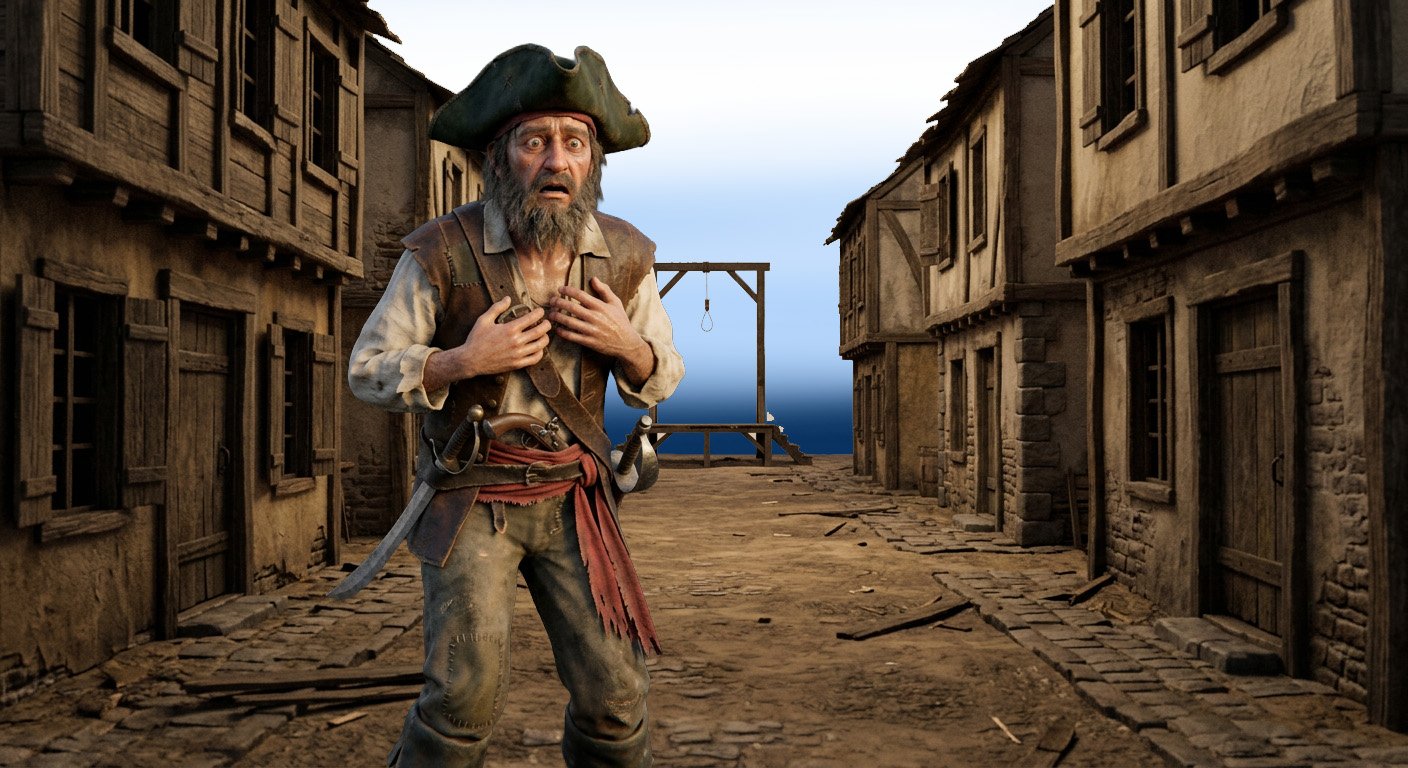
Pirates feared hanging more than death — not for the obvious reasons, but for what it meant for their souls. Blackbeard’s end was worse than he could have imagined.

Actually, this post has nothing to do with black cats, unless you are afraid of them. If you are, you probably know that your fear is prompted by superstition, and sailors in general have always been considered among the most superstitious group of people.

According to Kevin Duffus, in the The Last Days of Blackbeard,  pirates had a particular fear of hanging. Of course, who wouldn’t? Although dropping from a gallows may not sound too bad, the strangling and neck snapping just can’t be much fun. 
 
But for most pirates, hanging had a much more sinister meaning. In their superstitious minds it was far better to be killed in battle, on land or at sea. In either case, your body was buried, either in a grave (marked or unmarked, single or mass, that didn’t matter), or dumped over the side at sea. Your corporeal self was interred, and your soul could ascend to heaven. 
 
But, when pirates were hanged, their remains were often tarred over and left to rot as a warning to other would-be pirates. As their bodies were not interred, their souls were left to wander the earth, listless and lost, for eternity. 
 
For a man like  Black Beard it was far better to die with at least twenty pistol balls in his body and more than a dozen sword wounds, than to soil himself swinging from a gibbet in front of a jeering crowd.  Sadly for him, Lieutenant Robert Maynard, the Royal Navy officer responsible for his demise, decapitated the bearded giant and hung his head from the bowsprit of a ship for all to see. Poor Black Beard must still roam the wilds of North Carolina if that particular superstition be true! 
 
It brings a new light to the particular horror of cannibalism for sailors. Bad enough that the survivors in the boat eat the corpse of their fallen shipmate, they would actually have to divvy him up, preventing his soul from getting to heaven. That’s a rum go for any seafaring soul. 

Curiously enough, sailors had no fear of cats, black or otherwise. They were generally considered a part of the crew. Given their propensity for catching rats, they were probably a welcome addition.
 
I’m sorry if this post is a little gross – I do have a secret mission. I’m working on a plot to prove that pirates were not good people, and were very seldom sympathetic characters.  Thieves, robbers, thugs, murderers. And those are the kind names. You had to be pretty smart to command a pirate ship. But the kind of smart that these men honored was deviousness and cunning – things that should never be embraced by a civilized people. 
 
So, was you thinking of turning pirate, mate, be aware that you dunna have my blessing. And be ye wary of the noose! 

A Fortune Be Danglin’

Pirates wore earrings to show shipwreck survival, advertise wealth, or fund their burial. One of these theories holds up better than the others. Bob’s earrings tell the tale.

Why did pirates wear earrings? 
 
Well, there are a quite a few theories, but also some hard facts. 
 
This’d be a fact: was you a sailor up until around the year 1800, you would get yourself an earring to signify to them what saw you that you had survived a shipwreck. A sailor with two earrings, one in each ear, why, that fellow had survived two shipwrecks. Three earrings, three shipwrecks, and so on. 
 
I read a theory that pirates also wore earrings as a way to show their wealth. The danglies alongside their head would tell you at a glance whether this is a successful brigand, or simply a wannabe. 
 
While there is a little merit to this theory – who doesn’t want to advertise their success? – it runs into a bit of a problem when you think who pirates were. 
 
And by, who pirates were, I mean who pirates ARE, because there are a great many seafaring pirates out there today. Those guys with Uzis and motorboats that attack oil tankers and freighters and cruise ships in the quiet waters all over the world – thugs with machine guns and grenades – are every bit as much a pirate as Long John Silver and Captain Jack Sparrow. 
 
If one of these modern-day pirates were caught, say, by the Somalian Navy, they’d be hanged on the spot, and the world would cheer to be rid of the nasty fellow. As a consequence, modern day pirates keep a low profile, for fear of getting caught. 
 
The pirates of the Caribbean were no different. Vicious, rapacious murderers, they had nothing in their minds beyond what was in it for them.  Although they had some degree of brotherhood between themselves, they were viewed as a plague, and their hangings were accompanied by cheers from those that witnessed it. 
 
So, would a pirate walk about, surrounded by thieves and cutthroats, wearing a fortune dangling from his ears?  One has to wonder… 
 
Another theory says that a pirate wore his fortune on his ears that he might get a decent burial. I be dead, says I, but use me earrings to afford me a grave, would ye? 
 
As above, surrounded by thieves and cutthroats, one simply must wonder. 
 
– Hey, mate,Bob just died. And he’s got a fortune in diamonds hanging from his ear. 
 
-Don’t take them earrings, Jake. Bob wants us to use them to pay for his funeral. 
 
-Bob’s dead, mate – he don’t need no funeral. Shove him over the side – but gimme them earrings, first. 
 
Why did pirates wear earrings? Well, was they a sailor, it showed how many shipwrecks they survived. And, some chaps just liked the look of ’em. That’d be the true of it! 

Related Reads

Tales of the Black Falcon is part of the John D. Reinhart content family. Writer, illustrator, videographer, and accidental filmmaker — find the whole story at JohnDReinhart.com.

©2026 John D Reinhart/TalesOfTheBlackFalcon.com – all rights reserved
Blackbeard’s Three Mysteries

Blackbeard was the most famous pirate in history and almost nothing about him is actually known. Here are three mysteries that historians still can’t solve.

If you Google the name Blackbeard, everything you read will start with something like “Blackbeard was the most famous pirate…
 
For all the fame he acquired in the short 18 months of his piratical career, there is almost nothing known about him. He may have been in born in Bristol, England, or in Charleston, South Carolina. He may have had a sister. He may have buried his treasure.

May, may, may. There is so much to figure out about this particular felon.

One thing we do know about him is only a surmisal, but has to be true: he was certainly charismatic. He was able to get men to follow him. Yes, there was the lure of gold. But he had to have a magnetic personality to have attracted a crew of over 300 men.

For all that, here is a trio of mysteries that flow around the fabled captain.
 
Mystery #1 
 
Captain Charles Johnson, writing about pirates in 1724, referred to Blackbeard as the bloodthirstiest of pirates. He once sat at a table with his most trusted crewman Israel Hands and another fellow. As they chatted, Israel noticed that Blackbeard slowly lowered two pistols under the table, and he heard the click as Blackbeard cocked them. Fearing the worst, Israel leapt to his feet – but too late. A pistol ball smashed his knee. The second shot went wide. 
 
“Why on Earth did ye do that?” Israel bellowed. 
 
“If your crew don’t fear ye, they won’t respect ye,” came the laconic reply. 
 
And yet, many historians write that Blackbeard was far more fearsome than bloodthirsty. An educated man, he doesn’t seem to have done half the nasty things history says he did. 
 
Was he bloodthirsty, or was he crafty? And, as this is the only reference to his management style, do you suppose he was trying things out? Looking for ways to be a more effective leader?
 
Mystery #2 
 
Little pieces of a book were found inside one of the cannons recovered from the wreck of Blackbeard’s prized ship, Queen Anne’s Revenge. At first they were thought to have been pieces of his personal diary. Sadly, they turned out to have been torn from a popular book of the day about another pirate’s ocean voyage to Peru. 
 
According to the infamous Captain Johnson, Blackbeard kept a journal. The hope remains to find and decipher the exact location of the treasure he buried on his South Carolina plantation.

When asked where it buried, the pirate’s response was reported to be “that’s between me and the devil.” 

By the time Blackbeard reached his final days, he was in command of over 300 buccaneers – a circumstance with which he was not happy. He was equally aware that the Royal Navy was actively hunting for him.

Do you suppose that is what prompted him to bury his spoils? Did he actually bury them? Did he keep a journal? And, does the journal tell us where the treasure is buried? 

 
Mystery #3 
 
He was evidently quite proud of his ship Queen Anne’s Revenge. Originally a British ship, she found her way into France and into the French slave trade. When Blackbeard took her, she was pierced for 26 cannons. That’s an old naval term for you – pierced refers to square holes cut in the ship’s side to accommodate the guns.

Typical of English pirates of the day, Blackbeard apparently packed 14 more cannons into her. The English mindset of the day was the more cannons, the better. Adding so much weight to Queen Anne’s Revenge undoubtedly affected her trim and sailing capabilities and made her several tons heavier.

Marine archaeologists have found her, in the shallows off of Beaufort, North Carolina, and have brought thousands of her pieces ashore. To date they’ve recovered 30 cannons of all shapes and sizes. That makes sense, as the pirates would have stolen the guns from the various ships they captured.

Sadly, she ran hard aground, and was abandoned.

Here’s the mystery: did he run her aground on purpose?

As before, he had over 300 pirates following him. It’s possible that the weight of that command was too much for him, and he wrecked the ship so as to disperse the crew.

Or it may have been accidental: the gentleman pirate Stede Bonnet ran his sloop Adventure aground on the same sandbar just a few yards away at the same time.

Things aboard Queen Anne’s Revenge evidently got chaotic and a little vicious. Blackbeard had already abandoned 17 of his men on a desert islet, leaving them to starve if they didn’t first die of thirst. After the grounding he took command of the Adventure and sailed her off the bar at high tide, possibly without Bonnet’s permission, leaving the greatest part of his crew to fend for themselves in the wilds of North Carolina.
 
But the question remains: did he run Queen Anne’s Revenge aground on purpose?

There’s none can tell for sure, but research continues every single day to solve the mysteries of this most notorious Gentleman of Fortune.

Related Reads

Tales of the Black Falcon is part of the John D. Reinhart content family. Writer, illustrator, videographer, and accidental filmmaker — find the whole story at JohnDReinhart.com.

©2026 John D Reinhart/TalesOfTheBlackFalcon.com – all rights reserved
A Fanciful, Cranky Queen

She’s all skeletons and gunports and romance. She’s also top-heavy, diesel-powered, and would tip over in a stiff breeze. A cranky Queen, that one.

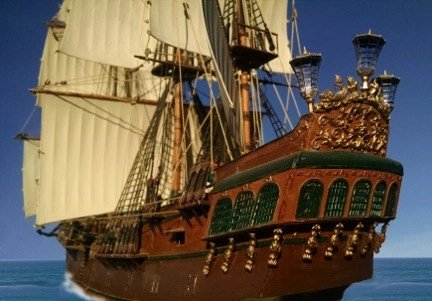
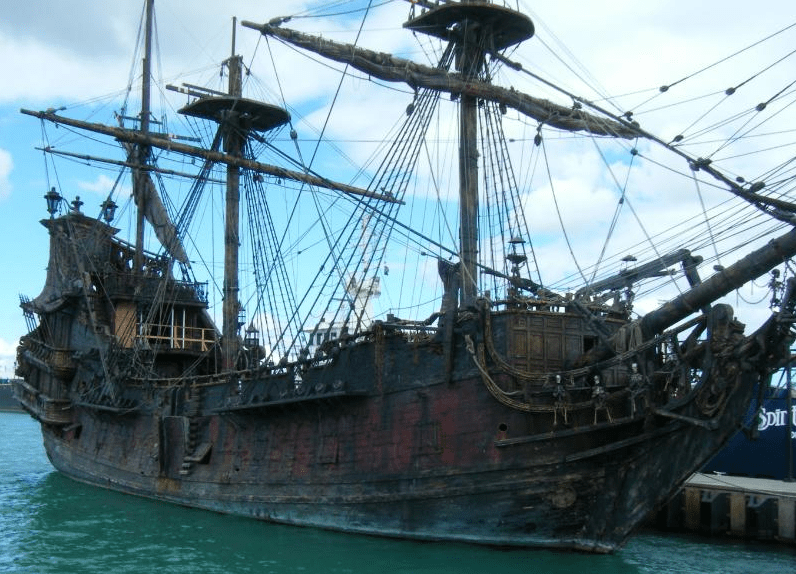
I’ve been looking for reasonable images of Blackbeard’s Queen Anne’s Revenge, and came across this cool photo. It’s labeled “Queen Anne’s Revenge Pirates of the Caribbean,” but I don’t think she’s related to either the real ship or those Disney movies.

Ah, but she’s a beauty, isn’t she? All carved and skeletons, and, wait, what’s with the piece of plywood there up there on the quarterdeck, just inside the railing of, what are those, 2x4s? Clearly a work in progress.

One of the things I find most interesting about sailing ships is how carefully they were designed to be symmetrical. Aside from the pure aesthetics of design, there were very serious reasons behind balancing a ship.

First, a ship needed balance from port to starboard, left to right. If one side was heavier than the other, she’d be difficult to steer, and could lay right over if the wind got too high.

And a ship needed to be balanced from fore to aft, front to the back. If she was heavy in the bow, for example, she’d plow nose-down through the waves when the wind got up, making her difficult to steer, and potentially flooding her forward parts. She’d be known as a wet ship on the best of days.

If she were down by the stern she’d be nearly impossible to steer in any kind of wind, and would almost sail sideways in anything but a stern-on breeze.

Captains could manage a ship’s fore-and-aft trim a little bit by shifting cargo in the hold forward or backward, but that wouldn’t compensate for a bad design.

A ship also needed to be balanced from the keel to the truck, from bottom to the top. Too much weight below the waterline and she would be sluggish and susceptible to getting swamped when the wind got up. Too much weight above the waterline and she might just tip over.

For example, the Swedish ship Vasa was so top heavy that she sailed only 1400 yards on her maiden voyage in 1628 before the wind laid her over on her beam ends and she sank. Sadly, with all hands.
 

So, let us imagine that  Queen Anne’s Revenge was actually built as pictured. First, let’s remember that Queen Anne’s Revenge is the name Blackbeard gave to the French slaver La Concorde, after he captured her.

According to National Geographic, he took her specifically because she was a slaver, and her crew was depleted by disease, and only half her gunports had cannons behind them. How he could have known all this in advance of meeting her is a little mystifying, but okay.

So he captures her and sets about setting her up as the flagship of his pirate fleet. This would have been around 1718, so the only power tools available were those that you powered yourself.

Perhaps those are all real skeletons, wired together and mounted out on the forepeak. That’s really creepy, and would take an immense amount of medical work and craftsmanship to get them to stay together, but it might have been easier to accomplish than carving them out of wood.  As our Mr. Beard had the Queen for less than a year, he must have had quite a contingent of artists and craftsmen in his crew. 

But that’s another story.

Keeping in mind that fore-and-aft symmetry we were talking about, it seems as if this Queen’s high, high stern would be heavy, and might push her bow right up out of the water. She sits level in this photograph because the heavy modern diesel engine must be placed as far forward as possible to balance her out.

She is a modern craft, after all, and clearly built to a shallow draft – which means she doesn’t sit very low in the water. That’s a challenge, as she appears to be pierced for at least 18 heavy cannons, all above the waterline of course, and those massive platforms at the top of the masts undoubtedly provide support for topmasts, and possibly even gallant masts above those. All those sails and guns and woodwork so far above the sea, and scant little hull to balance it below.

Yes, without the weight of those diesel engines below deck, she has very little compensation against the weight of her masts and sails, and the pressure of the winds. Sadly, she would be very difficult to sail on a nice day, and would find herself extremely challenged to stay upright on anything more than a slight breeze. 

Sailors would call her a crank ship – a right cranky Queen, that one.
 
But, she truly captures the romance of the pirates, doesn’t she? Skeletons and gunports and lanterns and those canvas awnings over the quarter galleries? She is a beauty.

And, was you with your telescope to espy a ship like that, perhaps a little better balanced, bearing down upon you from wind’ard with every sail drawing and a black flag at the peak, you’d find yourself having to make some very difficult decisions very quickly!

As a dramatic piece of art, she checks all the boxes.

As a realistic reference for Queen Anne’s Revenge, we might have to take a pass.

Ah, but she is fun to look at, isn’t she?

Related Reads

Tales of the Black Falcon is part of the John D. Reinhart content family. Writer, illustrator, videographer, and accidental filmmaker — find the whole story at JohnDReinhart.com.

©2026 John D Reinhart/TalesOfTheBlackFalcon.com – all rights reserved
Pity the Poor Marin Francais

The explosion of L’Orient at the Battle of the Nile killed a thousand men in an instant. Here’s who they were — and why they had no choice about being there.

English naval history is replete with heroes who rose from the lowliest gundeck position to command a king’s ship. The French not so much.

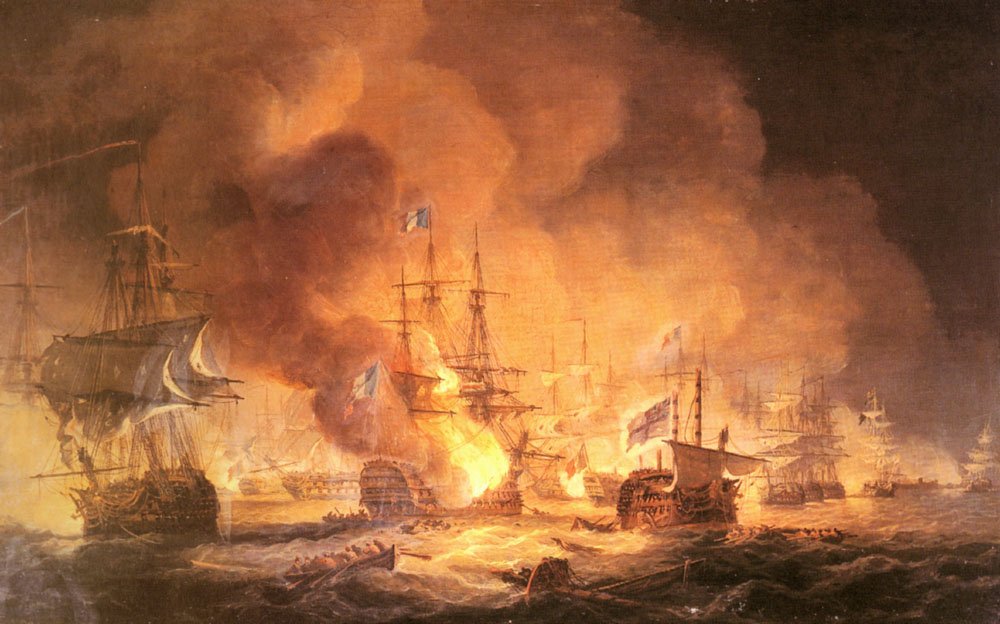
I’ve been thinking about the explosion of L’Orient at Battle of the Nile. During that battle, the massive 118-gun ship of the line, the flagship of the French Mediterranean Fleet, famously blew up when her 40-ton stockpile of powder caught fire. The explosion was so loud it was heard in Cairo, 150 miles away. It was an explosion so robust that it caused the battle raging between 24 ships of the line to pause for ten minutes, the ships’ crews stunned and awestruck.

L’Orient housed 1,079 officers and men. Although some of her crew might have been ashore, most would have been aboard when the battle began.

It’s those guys, all of whom perished in the blink of an eye, that give me pause. Brothers and sons, all but the officers unmarried, guys in the prime of their lives, blown to dust.

To be sure, life at sea was hard enough for any sailorman. Imagine living in a world forever damp, forever in motion, and forever filled with danger from every direction.

The sea was always around you, below you, trying to find a way in between the hull’s wooden planking. Water that crept in was pumped out daily

The wooden walls of your world were constantly drying out, becoming either soft or brittle. Wood rot was always a major concern for the ship’s boatswain and carpenter, officer and captain. The ship was drying to death underneath the tar that kept out the sea.

The wind forever tried to push your ship’s yards and masts over the side. Rigging was constantly renewed, for it became frayed and weakened by the efforts of the wind and sun and sea.

Fire was an ever-present hazard. A lantern overturned, a candle spilled, and your home would become a blazing inferno. Look at L’Orient.

The food was dreadful – a piece of salted beef that had to be boiled to become edible. A stew made up of oatmeal and lard, sometimes dried peas if you were lucky. Biscuits so hard you could break your teeth if you didn’t soak them, and often packed up with wriggling weevils. Flat beer because the drinking water was so bad. And watered rum, called grog, so that you wouldn’t complain.

Justice in the onboard society was at the whim of the captain and his officers. Most captains were decent, some weren’t. Captain Bligh, aboard HMS Bounty, was put over the side in 1789 by a mutinous crew. Captain Pigot, aboard HMS Hermione, was brutally hacked apart by his crew in 1797.

Yet it was the poor sailorman, crawling aloft in a gale, standing fast in a gunroom filled with fire and smoke and flying splinters, hauling at the windless on an icy deck, that kept these ships not only afloat, but powerful weapons in the war between nations.

Your English sailorman was conscripted, dragged from the pub or right off the street by a naval press gang. If he worked hard and kept his head and remained decent, however, he might make his way from, say, the gun deck to the quarterdeck. An intelligent, resourceful man could get promoted from common sailor to midshipman, accepting the king’s commission.

Your French sailorman was likewise conscripted. By law, he was to be unmarried, between the ages of 18 and 25, uneducated, and was pressed into service often against his will.

But the Marin francais, the French sailorman, had no opportunity to change his lot. By French law, officers were only selected from royalty. To even become an Elève de la Marine, or midshipman, you had to prove your royal heritage.

Your Marin francais was forever kept on the gundeck. He might move up in the ratings, become a gunner’s mate, for example. But he would never become an officer. You can imagine that his motivation would have been to survive, to get home, but not to innovate.

I come back to the thousand or so chaps aboard L’Orient, then. Like the galley slaves of old, their choice to be aboard that ship at that point in time was entirely out of their control.

What a remarkable, and remarkably tragic, event.

There are many, many fascinating things about the loss of L’Orient, which we’ll look into another time.

Related Reads

Tales of the Black Falcon is part of the John D. Reinhart content family. Writer, illustrator, videographer, and accidental filmmaker — find the whole story at JohnDReinhart.com.

©2026 John D Reinhart/TalesOfTheBlackFalcon.com – all rights reserved