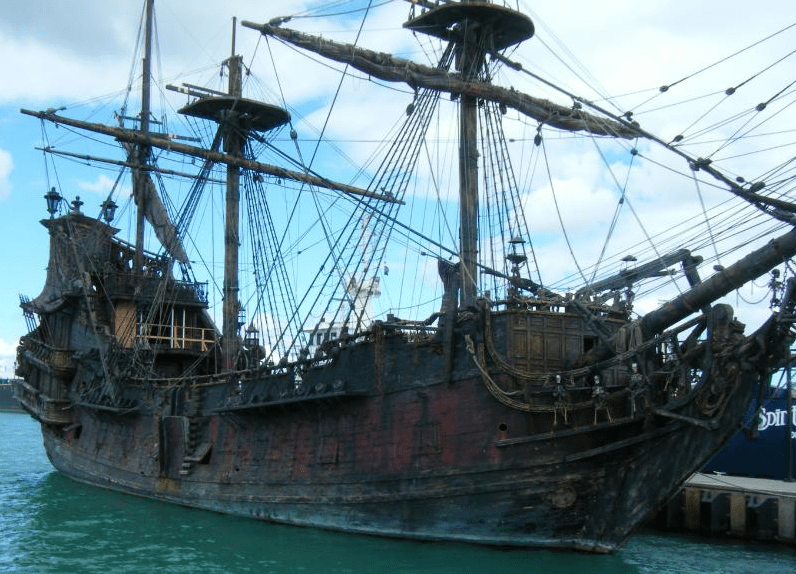
I’ve been looking for reasonable images of Blackbeard’s Queen Anne’s Revenge, and came across this cool photo. It’s labeled “Queen Anne’s Revenge Pirates of the Caribbean,” but I don’t think she’s related to either the real ship or those Disney movies.
Ah, but she’s a beauty, isn’t she? All carved and skeletons, and, wait, what’s with the piece of plywood there up there on the quarterdeck, just inside the railing of, what are those, 2x4s? Clearly a work in progress.
One of the things I find most interesting about sailing ships is how carefully they were designed to be symmetrical. Aside from the pure aesthetics of design, there were very serious reasons behind balancing a ship.
First, a ship needed balance from port to starboard, left to right. If one side was heavier than the other, she’d be difficult to steer, and could lay right over if the wind got too high.
And a ship needed to be balanced from fore to aft, front to the back. If she was heavy in the bow, for example, she’d plow nose-down through the waves when the wind got up, making her difficult to steer, and potentially flooding her forward parts. She’d be known as a wet ship on the best of days.
If she were down by the stern she’d be nearly impossible to steer in any kind of wind, and would almost sail sideways in anything but a stern-on breeze.
Captains could manage a ship’s fore-and-aft trim a little bit by shifting cargo in the hold forward or backward, but that wouldn’t compensate for a bad design.
A ship also needed to be balanced from the keel to the truck, from bottom to the top. Too much weight below the waterline and she would be sluggish and susceptible to getting swamped when the wind got up. Too much weight above the waterline and she might just tip over.
For example, the Swedish ship Vasa was so top heavy that she sailed only 1400 yards on her maiden voyage in 1628 before the wind laid her over on her beam ends and she sank. Sadly, with all hands.
So, let us imagine that Queen Anne’s Revenge was actually built as pictured. First, let’s remember that Queen Anne’s Revenge is the name Blackbeard gave to the French slaver La Concorde, after he captured her.
According to National Geographic, he took her specifically because she was a slaver, and her crew was depleted by disease, and only half her gunports had cannons behind them. How he could have known all this in advance of meeting her is a little mystifying, but okay.
So he captures her and sets about setting her up as the flagship of his pirate fleet. This would have been around 1718, so the only power tools available were those that you powered yourself.
Perhaps those are all real skeletons, wired together and mounted out on the forepeak. That’s really creepy, and would take an immense amount of medical work and craftsmanship to get them to stay together, but it might have been easier to accomplish than carving them out of wood. As our Mr. Beard had the Queen for less than a year, he must have had quite a contingent of artists and craftsmen in his crew.
But that’s another story.
Keeping in mind that fore-and-aft symmetry we were talking about, it seems as if this Queen’s high, high stern would be heavy, and might push her bow right up out of the water. She sits level in this photograph because the heavy modern diesel engine must be placed as far forward as possible to balance her out.
She is a modern craft, after all, and clearly built to a shallow draft – which means she doesn’t sit very low in the water. That’s a challenge, as she appears to be pierced for at least 18 heavy cannons, all above the waterline of course, and those massive platforms at the top of the masts undoubtedly provide support for topmasts, and possibly even gallant masts above those. All those sails and guns and woodwork so far above the sea, and scant little hull to balance it below.
Yes, without the weight of those diesel engines below deck, she has very little compensation against the weight of her masts and sails, and the pressure of the winds. Sadly, she would be very difficult to sail on a nice day, and would find herself extremely challenged to stay upright on anything more than a slight breeze.
Sailors would call her a crank ship – a right cranky Queen, that one.
But, she truly captures the romance of the pirates, doesn’t she? Skeletons and gunports and lanterns and those canvas awnings over the quarter galleries? She is a beauty.
And, was you with your telescope to espy a ship like that, perhaps a little better balanced, bearing down upon you from wind’ard with every sail drawing and a black flag at the peak, you’d find yourself having to make some very difficult decisions very quickly!
As a dramatic piece of art, she checks all the boxes.
As a realistic reference for Queen Anne’s Revenge, we might have to take a pass.
Ah, but she is fun to look at, isn’t she?
Related Reads
Tales of the Black Falcon is part of the John D. Reinhart content family. Writer, illustrator, videographer, and accidental filmmaker — find the whole story at JohnDReinhart.com.
©2026 John D Reinhart/TalesOfTheBlackFalcon.com – all rights reserved


 Tales of the Black Falcon
Leave a comment