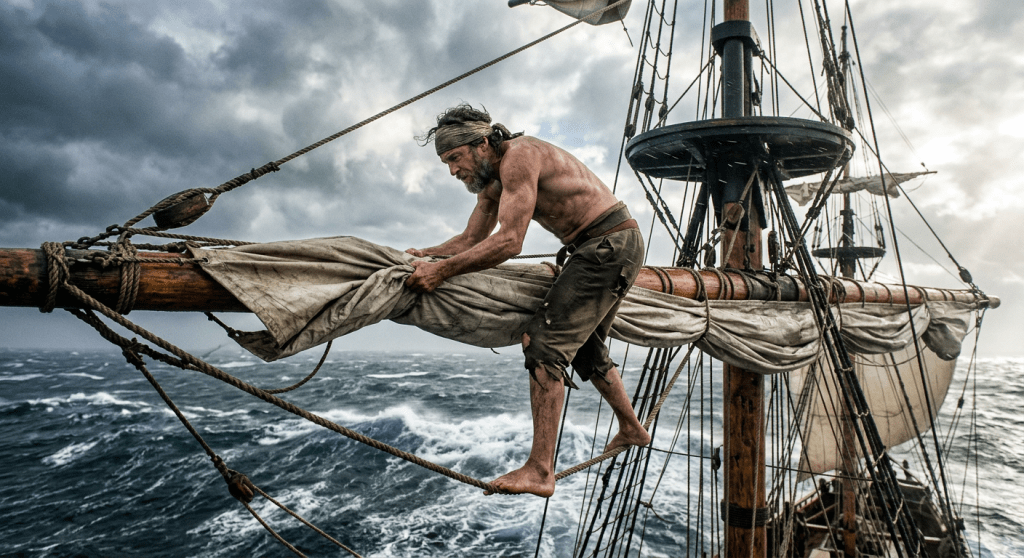
Despite that Disneyland song that goes Yo Ho, Yo Ho, a pirate’s life would not be for most people.
A blue water sailor’s job during the Golden Age of Piracy, from around 1675 until 1715 or so, was not easy. Reefing sails, hauling braces, trimming yards – those things were massively physical tasks on the sunniest of calm days. Performing them in the teeth of a gale in the dead of night took almost superhuman resolve and tenacity.
That sailor’s life was a constant physical struggle. Things were forever damp, and his quarters were terribly cramped. Captains could be oppressive, creating what we now call a hostile work environment, with bullying and harassment and worse, the food was often bad, and with little to drink beyond rum and beer, you can see what would make a sailor’s life a misery.
Now, you would assume that your pirate, sea rover, gentleman of fortune, buccaneer, corsair, freebooter, call him what you like – a scallywag – would have had things better, wouldn’t you?
In truth, he had it worse.
All those dreadful realities that faced a common sailor were exactly the same for a common pirate. Oh, maybe the food was a little better, and the management a little less oppressive.
But the work of sailing a ship continues whether the hand on the rope belongs to a sailor or a pirate. The weather treats each with equal disdain, and the sea doesn’t care.
And once a man turns pirate, there is no going back. Wherever he goes in the world, he’s a pirate, and he can be hanged by any civilized navy.
Let’s say he goes home to visit his sister. A sailor in the pub recognizes him and tells the local magistrate. The soldiers show up and he’s marched off to jail, from there to be hanged. There’s no justice for a dirty pirate.
Let’s say he quits a’pirating, and instead becomes an honest sailorman. One day one of the crew recognizes him and tells his captain. The ship’s captain can hang him, too.
Let’s say he quits the sea – what is it he can do for a living? Beg? That happened often enough.
“I be an honest man, cap’n,” he tells the landowner. “Tending cows is what I did before I took to the sea, you understand.”
The merciful landowner hires him, and he lives in the barn and has regular, simple meals. But them folks at the pub start to whispering, and pretty soon the truth comes out and the noose goes around his neck.
Nope. Once he’s gone to the dark side, there be no turning back. That has to weigh on his soul. How could he have been so stupid?
Worse still, it was so easy to turn pirate. His own ship was taken by pirates, the crew subdued and cowed by nasty looking men with cutlasses and pistols.
“Who here will join us? Who here will take the free and easy course to riches?” says the pirate captain.
No more work aboard this barge, the sailor thinks. Goodbye, Captain Surly, and hello, freedom. Not a hard choice when you put it that way. He lowers his hands and joins the fellows with swords and guns.
“Don’t do it, Jim,” his shipmate whispers. “Them’s the devil.”
“Shut up,” one of the pirates snarls, and the shipmate shuts up. Just like that he joins the crew of the pirate ship, and the doors of civilization slam shut behind him.
Or, worse, he’s a medical man – read up in a book or perhaps had some schooling and takes care of the crew aboard a merchantman.
His ship is boarded by these grimy, barefoot men who swear and kill without remorse.
“What about you?” the pirate captain asks, his pistol pointed at the doctor. “What is it you do?”
“I, uh, am the ship’s doctor,” he replies timidly.
“You’ll be coming with us,” the captain replies. “We has need of a doctor.”
Sailmakers, coopers, doctors, blacksmiths, fellows who could navigate and steer, all were needed aboard ships that sailed under the black flag. And, like our simple pirate, they would forever be branded as sea rovers.
Piracy was a business of fear and intimidation. Unless you were the one doing the intimidation, your life could not have been very pleasant.
Money, riches, even wealth, did trickle into the hands of the common pirate, but it most often trickled right back out again. Most left this earth as poor as when they entered it.
There were exceptions, of course, and we’ll talk about those further along in our voyage.
An easy, carefree life has never been the lot of the poor sailorman, whether he was honest or sea rover.
Yo ho, yo ho, indeed.
Related Reads
Tales of the Black Falcon is part of the John D. Reinhart content family. Writer, illustrator, videographer, and accidental filmmaker — find the whole story at JohnDReinhart.com.
©2026 John D Reinhart/TalesOfTheBlackFalcon.com – all rights reserved


 Tales of the Black Falcon
Leave a comment