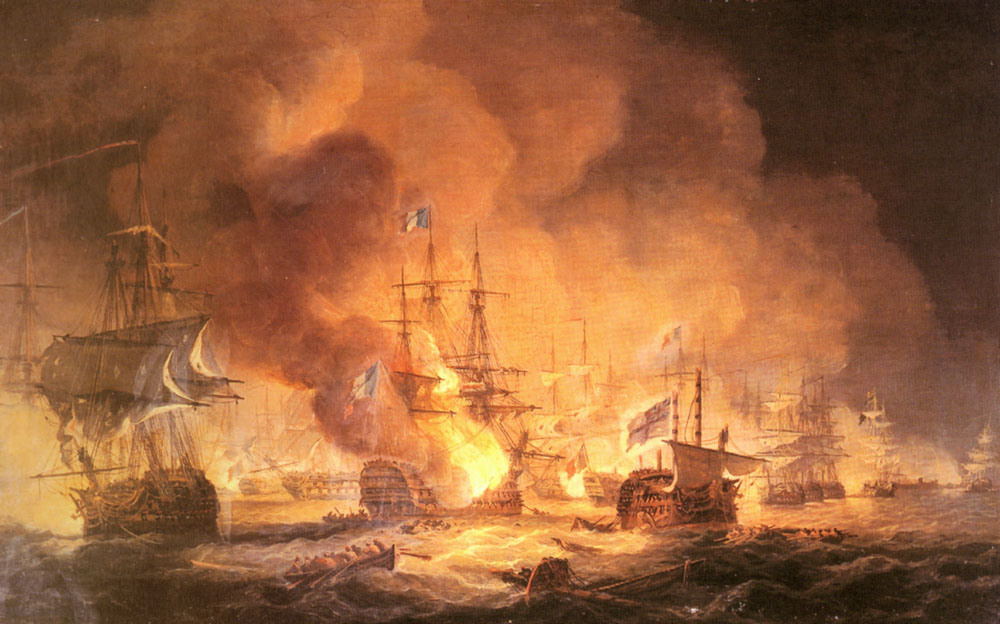
English naval history is replete with heroes who rose from the lowliest gundeck position to command a king’s ship. The French not so much.
I’ve been thinking about the explosion of L’Orient at Battle of the Nile. During that battle, the massive 118-gun ship of the line, the flagship of the French Mediterranean Fleet, famously blew up when her 40-ton stockpile of powder caught fire. The explosion was so loud it was heard in Cairo, 150 miles away. It was an explosion so robust that it caused the battle raging between 24 ships of the line to pause for ten minutes, the ships’ crews stunned and awestruck.
L’Orient housed 1,079 officers and men. Although some of her crew might have been ashore, most would have been aboard when the battle began.
It’s those guys, all of whom perished in the blink of an eye, that give me pause. Brothers and sons, all but the officers unmarried, guys in the prime of their lives, blown to dust.
To be sure, life at sea was hard enough for any sailorman. Imagine living in a world forever damp, forever in motion, and forever filled with danger from every direction.
The sea was always around you, below you, trying to find a way in between the hull’s wooden planking. Water that crept in was pumped out daily
The wooden walls of your world were constantly drying out, becoming either soft or brittle. Wood rot was always a major concern for the ship’s boatswain and carpenter, officer and captain. The ship was drying to death underneath the tar that kept out the sea.
The wind forever tried to push your ship’s yards and masts over the side. Rigging was constantly renewed, for it became frayed and weakened by the efforts of the wind and sun and sea.
Fire was an ever-present hazard. A lantern overturned, a candle spilled, and your home would become a blazing inferno. Look at L’Orient.
The food was dreadful – a piece of salted beef that had to be boiled to become edible. A stew made up of oatmeal and lard, sometimes dried peas if you were lucky. Biscuits so hard you could break your teeth if you didn’t soak them, and often packed up with wriggling weevils. Flat beer because the drinking water was so bad. And watered rum, called grog, so that you wouldn’t complain.
Justice in the onboard society was at the whim of the captain and his officers. Most captains were decent, some weren’t. Captain Bligh, aboard HMS Bounty, was put over the side in 1789 by a mutinous crew. Captain Pigot, aboard HMS Hermione, was brutally hacked apart by his crew in 1797.
Yet it was the poor sailorman, crawling aloft in a gale, standing fast in a gunroom filled with fire and smoke and flying splinters, hauling at the windless on an icy deck, that kept these ships not only afloat, but powerful weapons in the war between nations.
Your English sailorman was conscripted, dragged from the pub or right off the street by a naval press gang. If he worked hard and kept his head and remained decent, however, he might make his way from, say, the gun deck to the quarterdeck. An intelligent, resourceful man could get promoted from common sailor to midshipman, accepting the king’s commission.
Your French sailorman was likewise conscripted. By law, he was to be unmarried, between the ages of 18 and 25, uneducated, and was pressed into service often against his will.
But the Marin francais, the French sailorman, had no opportunity to change his lot. By French law, officers were only selected from royalty. To even become an Elève de la Marine, or midshipman, you had to prove your royal heritage.
Your Marin francais was forever kept on the gundeck. He might move up in the ratings, become a gunner’s mate, for example. But he would never become an officer. You can imagine that his motivation would have been to survive, to get home, but not to innovate.
I come back to the thousand or so chaps aboard L’Orient, then. Like the galley slaves of old, their choice to be aboard that ship at that point in time was entirely out of their control.
What a remarkable, and remarkably tragic, event.
There are many, many fascinating things about the loss of L’Orient, which we’ll look into another time.
Related Reads
Tales of the Black Falcon is part of the John D. Reinhart content family. Writer, illustrator, videographer, and accidental filmmaker — find the whole story at JohnDReinhart.com.
©2026 John D Reinhart/TalesOfTheBlackFalcon.com – all rights reserved


 Tales of the Black Falcon
Leave a comment