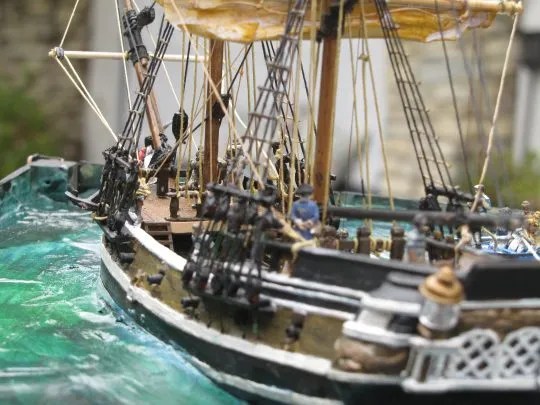
Now, before you say anything about the size of the deadeyes or the curious backdrop, take a moment and look at the picture. Feel the romance of the little Black Falcon, the pseudo-scaled plastic model sailing ship. Think about the old Aurora kit for a minute.

If you don’t know anything about the old Aurora kit, or the Smer kit, or the Polar Lights kit, or the new Atlantis kit – like her subject, the model Black Falcon has traveled quite a bit herself – that’s okay. Look her up online, and you’ll see how simple and oddly scaled she is. How thick those shrouds are, and what’s up with those triangular shapes at the masthead? What are those things?

If you know about the model kit, you’ll know that she was never assigned an actual scale, because she hailed from the days when the scale of the model was determined by the size of the box into which it would fit. Even by that standard, however, the model kit was grossly out of scale with itself: the person who would match the steps on the ladders would easily fall between the ratlines, the cannons would be taller than he was, and he’d never reach the spokes on the wheel. Those odd little rounded doorways on the forward bulkhead. For whom were those intended? Hobbits?
Beyond those goofy mastheads and odd doors, there were enormous bollards molded onto the deck, along with the occasional coiled rope. And the pinrails for each of the masts were turned into odd boxes, like planters out of which grew the mast.

For all that she was a lovely ship, with smooth underwater lines and a distinctly romantic shape. The underwater shape is too shallow for a ship of her length, but, hey, right?
I have loved that shape since the mid-1960’s, when I first found her for $.98 at the corner dime store. Who cared about the gross scaling and the clumsy molding. She was a ship, with guns! But no matter what size sailor I’ve tried to fit aboard, they’ve all clashed with something: the guns are too small, or the steps are too small. And, regardless, those molded ratlines are just gross.
So, one evening, I realized that I could use Popsicle sticks and dowels to make a better mast. It sounds dumb, but it’s true. And I did. And it didn’t stop there. A real wooden deck. Clear windows. Correct ladders…the list went on and on. Goes on and on, for I’ve not finished with her yet. Ratlines, deadeyes, skylight, even the figurehead is different.
This blog is about that process, the conversion of the old, oddly scaled plastic Black Falcon into a ship that could reasonably fit a 1/87 HO scaled crew. Together we’ll learn how to make the many things that go into scratchbuilding a sailing ship from a plastic model kit.

A couple of admissions. That picture is of a modification of Heller’s 1/100th scale Soleil Royale, a 104-gun ship of the line from the late 1600’s. Oh, she’s a lovely kit: enormous vacu-formed sails, a hundred guns, blocks and yards and carvings galore. But, she, too, is a grossly inaccurate model. Silly things like comically inaccurate cannons, and beautifully-shaped boats with utterly smooth hulls. Things so bad that I couldn’t see putting any more effort into her. I literally abandoned ship, choosing in desperation to cut her down to a 50-gun razee.
Navies that found themselves straddled with an out-of-date, over-gunned ship of the line sometimes sheared off the upper decks and works to make them sail better and more efficient. The result was referred to as a razee. Hey, Naval History! Who knew?
Anyway, that project went into the trash because her shape didn’t lend itself to anything that would work, and it was far more difficult than I had patience for. Plus she listed to starboard in the pool! But I saved a bunch of her pieces, and some of those are used in the Black Falcon.
One more word about nautical history: evolutionary. No single piece of sailing ship technology was produced in its final form right out of the gate. Just like life, the structure of a ship, her rigging, her sails, her various technical bits, all changed and refined over time. That means that, for a rather generic ship like the Black Falcon, there can be no exact representation of how she looked on a specific day. Be free! Have fun!
Okay, I must tell you the truth: I’m a terrible modeler. Really bad. I’m a really great artist, with a superb vision, but I have no patience. I don’t plan things out. I’m sloppy. I’m a lousy knot-tier. I choose expediency over accuracy because I have no patience. And I’m an awful gluer. Sloppy Joes are my go-to.
You see, I’m a writer. A romantic. A would-be once-upon-a-time sailor trying to get back to the sea. I’m just not a very good modeler.
But the ideas you’ll find here, however poorly executed, are good, and I hope you find them useful.
There, I said it.
Tales of the Black Falcon is part of the John D Reinhart content family. Writer, illustrator, videographer, and accidental filmmaker — find the whole story at JohnDReinhart.com.
©2026 John D Reinhart/TalesOfTheBlackFalcon.com – all rights reserved


 Tales of the Black Falcon
Leave a comment