Plastic pirate ship kits always try to include some cool looking cannons. I mean, really, what were pirates without cannons?

Even the Orion English Pirates kit includes two cannons – two! And, except for the plugged barrels, those cannons are nice! I read somewhere that the soft, bendy plastic used in army men and most 1/72 scale figure kits is something called polythene.
Whatever it’s called, the stuff is a challenge to work with. It doesn’t carve well, doesn’t hold onto paint, and is really tough to glue. Boring out the cannon barrel? Forget about it.
But I digress.

Let us consider the range of great guns presented in this picture. The chap is 1/72nd scale, I believe, and lingers there for reference.
On the right is exhibit E: one of the massive 24-pounders from Revell’s 1/96th scale USS United States. It it a superb model, taken from the guns aboard the USS Constitution in Boston Harbor.
Exhibit D: a medium-sized gun from Heller’s 1/100th scale Soleil Royale. The after end of the barrel extends way beyond the trunnion, which would have made it almost impossible to manage on a moving deck. Inaccurate on a good day.
Exhibit C: a gun from Zvezda’s Black Swan in 1/72nd scale. A beautifully detailed, apparently accurate kit of 7 parts all by itself, it looks to be a 12-pounder piece, standard for the early 1700’s.
Exhibit B: the gun from Orion’s English Pirates set. A good, clean model – not a ton of detail, but it looks correct next to our fellow. Sadly, it’s molded in the above-mentioned polythene. Tragic.
Exhibit A: a gun from the Black Falcon. Ahem.
The cannons that come with the Atlantis Black Falcon kit are one-piece guys: barrel and carriage are molded together. They’re stubby, of no particular scale, and are just the cutest things you’ve ever seen, cannon-wise.
So, let’s assume that they’re very old. Older guns were stubbier, because the science of iron working wasn’t very well developed, and the extra girth of the barrel help prevent explosions.
The bore would be about the size of an HO scale fella’s fist. So, maybe the shot weighed about six pounds. A six-pounder gun was a formidable weapon, and just small enough to fit aboard the Black Falcon.

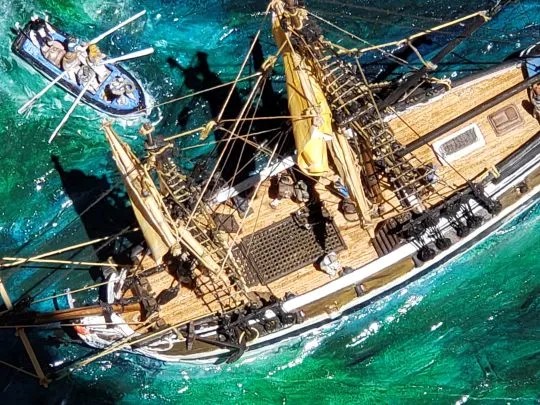
In reworking the Black Falcon, deck space was at a premium, so I opted to use the tiny guns that came with the ship. From a distance, they don’t look too bad.
It’s an interesting piece of history that you wouldn’t expect, but think about it: you own the ship, you want to provide guns for her protection, but how big should the guns be? Beyond the weight of each cannon, the amount of space it takes on the deck is a major factor.

If you bore them out with a small drill bit, the guns almost look formidable, although, as you can see, the bore varies somewhat between guns…

One of the quirky things about the Black Falcon as molded is that half of her guns were fake – just barrel stubs pointing out of the ports. Back in the day these would have been called “quakers,” and were carved out of wood by the ship’s carpenter. The idea was to make the ship look more formidable by mounting more cannons.
Cannons, as you can imagine, were a treasured commodity. When pirates took a ship, they often took the ship’s cannons to upgrade their own. Although bulky and difficult to store, they were a critical supply item to those ships that had lost one in combat, or had sailed with empty gun ports.
There, now, you’ve got me talking like a sailor again. Empty ports: no gun for that port. Lost in combat? Sure! Cannons were as susceptible to cannon fire as anything else on board a ship. And, a badly-sized ball shoved down the barrel, or too much powder, could cause the gun to explode.
One more quirky detail about the Black Falcon‘s little cannons: instead of wheels on the bottom of the carriages, her guns seem to have rollers, like a Flintstones car! In addition to drilling out the bore, you can make the gun look much better by filing out the space between the wheels:

Now you know all about the guns of the Black Falcon.
Except one more thing: the guns didn’t just sit on the deck. The darned things were on wheels, and weighed as much as a ton. So, as you can imagine, tying them down was a rather high priority. It happened once in awhile that a gun would come loose during a storm and fall right through the gratings in the gun deck, plummet through the hold, and crash right through the bottom, creating a massive and deadly hole.

Although this picture is a little hard to see, I used the plastic training tackle pieces that came with Zvezda’s Black Swan kit to anchor the Black Falcon‘s guns. Between the slope of the bulwark, the ship’s side, and the angle of the deck, it was virtually impossible to get the two pieces of tackle to align horizontally, but the illusion is not bad.
Imagine running down that ladder with no handrail and finding that cannon right there at the bottom! Talk about your workplace injury!
And, another thing about cannons: When in battle, managing the guns and the sails requires the crew to be in two places at once. While one group of sailors is needed to load and fire the guns, another group is needed to turn and trim the yards to follow the wind.
To change tack, or even to trim a yard, the sailors form a line to haul on the ropes tied to the tip of the yard. Imagine trying to haul the guns in to reload while avoiding this line of men tugging on the ropes – chaos!
To avoid that, I tied the braces off at the fore- and quarterdecks, so that her crew is neatly divided between sail handlers, on the upper decks, and gun crews, on the lower deck. Dang, they shoulda made me the cap’n…
One more thing, and I promise this is the last: why are the guns run out?
Historically, when the ship was at sea and not in battle, the cannons would be rolled inboard, and the gunport doors closed. This was a good way to protect the iron barrels from weathering, and to keep the ship drier.
In port, as in the setting for the Black Falcon, especially in the tropics, the ports were opened to allow air to circulate around the gun deck. If the ship was in a potentially dangerous port, the guns might be run out, ready to open fire in defense.

For the model, I envisioned her in a tropical bay, warm sun beating on the decks, and the ports open to allow the sultry breeze to cool things down. Just like the boxtop!
In reality, there’s really not enough space on that deck to roll the guns in, and I would have had to model port lids, and, to “bowse” the guns against the side, the barrel was raised to it’s maximum elevation to allow the gun to fit snugly out of the way. Bowsing those one-piece guns? Forgeddaboudit!
Tales of the Black Falcon is part of the John D Reinhart content family. Writer, illustrator, videographer, and accidental filmmaker — find the whole story at JohnDReinhart.com.
©2026 John D Reinhart/TalesOfTheBlackFalcon.com – all rights reserved


 Tales of the Black Falcon
Leave a comment