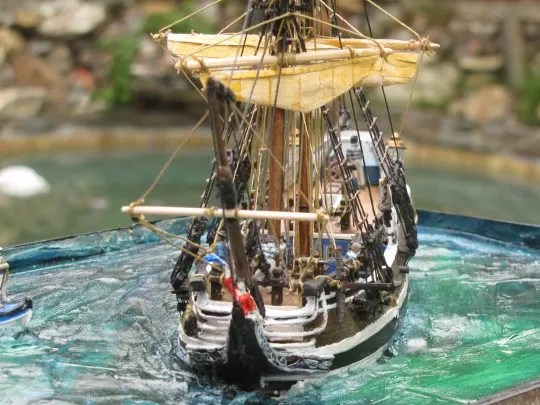
A quick word on deadeyes: these were sets of two wooden, three-hole blocks, or actually just a wooden disk with three holes drilled through it. One block was tied to the end of a rope, called a stay, that led up to the mast’s top, while the other was chained to the ship’s side. Between the two blocks was laced another length of rope, woven through the three sets of holes. The knot in this rope could be adjusted, to the effect of tightening or slackening the stay.
The stay, when ganged together with other stays, were called shrouds. The shrouds kept the mast straight from side-to-side, and provided some fore-and-aft support as well.
The Atlantis Black Falcon kit comes with some molded plastic shrouds that are heavy and about twenty times thicker than the ropes they’re supposed to represent. The deadeyes at the bottom are so vague as to be unrecognizable
If you plan on replacing those shrouds, you’ll have to replace the deadeyes, too.
If you’ve ever rigged your own deadeye assemblies, you know they can be excruciatingly difficult. Especially on smaller scale models like the Black Falcon, the little fiddly bits are excessively fiddly.
You could make a jig to hold the two blocks apart, and then carefully wrap them together. The jig needs to place the blocks apart at a scale distance and yet allow you access to both sides and the space between them in order to rig them.
Or you could use wire. Yes, wire. Cut and bent to a standard length, crazy glued to the holes in the blocks, squeezed together, and painted black to simulate a tar coating.

As long as you bend the wire at the same place every time, your deadeyes cannot help but be identical.

Measure the plastic deadeyes carefully. I didn’t, instead eyeballed it, and mine are hugely big. They are, however, more scale looking than the plastic ones. I think. Here on the mainmast they look okay, as if a sailor like that pegleg fellow could leap from the rail and climb the shrouds.

On the foremast, however, heaven help the poor sailorman who must climb into those ratlines!
Tales of the Black Falcon is part of the John D Reinhart content family. Writer, illustrator, videographer, and accidental filmmaker — find the whole story at JohnDReinhart.com.
©2026 John D Reinhart/TalesOfTheBlackFalcon.com – all rights reserved


 Tales of the Black Falcon
Leave a comment