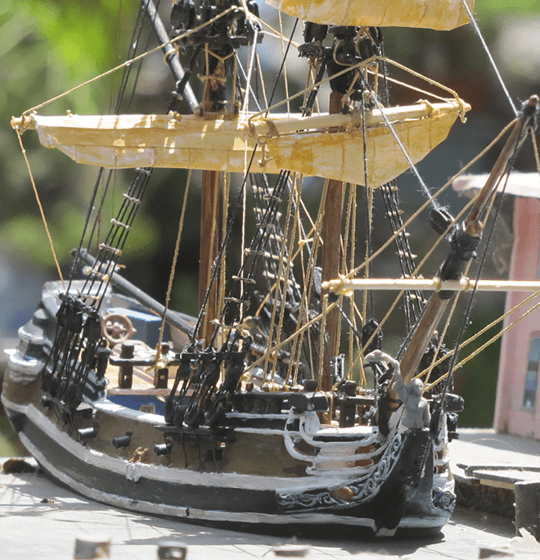
When we were younger, it was okay to cut a piece of copier paper to the right size and plastic-cement it to the ship’s yard. The cement soaked into the paper and made a pretty good bond.
Boy, has THAT ship sailed.
It turns out to be not so very hard to make realistic looking paper sails. This is a technique I read about on modelshipworld.com. Although the author of that post did a much better job than I did, his idea works pretty well. Read his post – it’s really good.

Assembly
Rather than use a single piece to replicate the sail, the idea is to cut long strips (1) and glue them together with a slight overlap. In the illustration the edge is staggered to show you the method, but of course you would make them straight.
The Black Falcon is roughly HO scale, or 1/87, so the sail panels shouldn’t be terribly wide. Mine were cut to 1/2 inch.
Gluing the strips together is a messy proposition. I tried a bunch of different methods, most of which turned out pretty bad. The best results came with a glue stick applied to both edges of the panels. Gluing only one panel turned out kind of like a Post-It note. Controlling the glue stick is very difficult, especially if you’re naturally sloppy like me, and the glue gets everywhere.
But these aren’t new sails, right? I mean, look at that color, right? So it’s okay if they’re just a little sloppy, right?
To make the border of the sail, I cut some strips at half-width, or a quarter of an inch. I then folded those in half lengthwise (2), applied glue stick glue inside the fold and to the border of the sail, and stuck ’em down.

This is the main tops’l, in a not-quite-so-finished state. You can see the overlapped strips, and the folded border pieces.
Stressing
No, this isn’t about stressing out over how to make the sails. This a method of working the paper to make it more pliable and cloth-like.
Remember when you made treasure maps as a kid and you worked the paper over the edge of a table to make it seem more like parchment or cloth?
The same method comes in really handy here. Stress the crackers out of your assembled sail by working it between your fingers, by dragging it over the edge of a table, and by wrinkling it and unwrinkling it. Each time you do it, the paper gets softer and picks up more grain.
However, you’re going to stress the joints between the panels, and they’ll probably come unglued.
Don’t come unglued yourself, just stick them back together and keep going.

Furling
Furling your sails – rolling them up to the yards – is a surprisingly difficult challenge with paper sails. The paper is much thicker than the canvas it replicates, and a rolled-up full-sized paper sail looks stupid with two o’s.
Trim the bottom edge of the sail to get rid of the material, and then roll/fold it under to look somewhat furled. The joints in the paper don’t like to roll, so it takes some patience, but you can eventually achieve a pretty good furled-sail shape. Pretty good. I haven’t yet found the combination of stressed paper, cut edge, and rolling that really works.
Painting
To keep them from looking like they were cut from a Dixie Cup, you’ll need to paint your sails. The one in the close-up picture has been roughly painted with a mix of umber and white acrylics, rather thinned down to avoid a uniform finish. Clearly I need to finish the paint job.
But you can see how the paint darkens the seams between the panels, adding a ton of depth and detail to the sails.
Attachment
There be’s another post on this site that talks about making yards, and suspending a wire underneath. You doesn’t tie yer sail directly to the yard, ye see (oh, now you’ve got me talking like a pirate.) There’s a rail, called a jackstay, that runs the length of the yard, and is the place to which the sail attaches.
The gentleman who wrote the article linked above tied his sails down. That’s easy if you’re energetic and have only the one, big, fore-and-aft sail in his article. If you’re lazy like me, your sail is glued to this rail, rather than tied. Super-glued, so that it doesn’t come loose.
That being said, my fore course has come somewhat loose in the main picture for this post. Rats.
Tales of the Black Falcon is part of the John D Reinhart content family. Writer, illustrator, videographer, and accidental filmmaker — find the whole story at JohnDReinhart.com.
©2026 John D Reinhart/TalesOfTheBlackFalcon.com – all rights reserved


 Tales of the Black Falcon
Leave a comment