Chain whats? Chain wales, my friend. Although you’ll find many a seaside tourist trap hawking sailing ship models crafted by people who’ve never laid eyes upon a square rigged ship, or a ship, or quite probably the sea for that matter, featuring shrouds tied off straight to the hull, never since the year 1400 was there a masted sailing vessel that didn’t feature some degree of wale.
Ah, wales. Neither the country nor the seagoing mammals, wales, according to Chapman, are “the thickest strakes of wrought stuff in a vessel.” Thank you, Captain. That clears it up.
The outside of a ship’s hull was planked in a fore-and-aft direction with long timbers of a uniform thickness. A certain few timbers, however, were thicker, and more robust. These were called wales. Usually there was one down above the waterline, intended to fend off wayward boats. Another was up at the top of the side, intended as a steady rest platform for chaps with muskets. It was called the gunwale.

The masts were supported front and back by ropes called forestays and backstays. and from side to side by ropes call stays singularly, but when grouped together were called shrouds. The shrouds provided by far the highest percentage of support for the mast.
As I’m sure you know, the mast wasn’t fixed to the ship. There was truly no way to bolt it to the fabric of the ship. Instead, the mast was lowered using another vessel called a masting shear, through the ship’s decks, down and down until it rested on the keel. Wedges were driven in the deck holes through which it passed to hold it place, but they weren’t very strong, and could come out. The mast was held down against the keel by the shrouds.

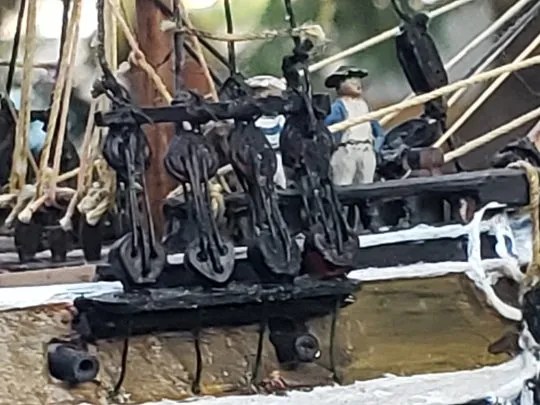
The shrouds stretched from the top – the maintop, foretop, etc – down to the side of the ship. To protect the ropes from the gunwale, a stout wooden plank extended from the hull as a standoff. This plank was called the chainwale.
And it was called the chainwale, often shortened to channel, because the ends of the individual stays in the shroud were chained to the hull to keep them from coming loose.
Man, that was a long way to get around to explaining that, just like the deck planking and the tops, Popsicle sticks once again provided the material for the Black Falcon‘s chainwales.
In my novel The Diary of Phineas Caswell, our eponymous young protagonist spends quite a bit of time sitting out on the mainmast chainwale, so it was important for me to create these correctly. Although it’s a circuitous way to sell a book, these chainwales provide a pleasant link between the fictitious plastic Black Falcon and the fictitious Kathryn B.

The chainwales molded into the Black Falcon’s sides were quite shallow – although that’s a subjective term as the model had no real scale – and, to make it easier both to mold and build, the chains were molded as solid triangles! It looked kinda cool, like those tract houses from the 50’s that had Dutch-style gingerbread to make them look more expensive. But it was wrong. Just wrong.
So, job number one was to sand them off. And that was quite a job.
At first I’d hoped to use the chainplates from the defunct Soleil Royale, but the hole spacing for the shrouds was all wrong, and the plastic was too brittle to work with. Plus, those things were huuuuuge compared to the tiny Black Falcon.

Instead, I used Popsicle sticks, cut in half lengthwise. They had the right amount of heft to hold up to the rigging that was to come.
So, I had a glorious plan to drill micro-sized holes near the outside edge of the wale, and then actually and accurately rig a shroud from the hull to the top. Ideally, the shroud would connect below the chainwale, pass up through the chainwale, through the deadeyes, up the top and over the mast, back down the other side, through the deadeyes, the other chainwale, and back into the hull. And I’m certain there is a modeler that has done that.
Not this one.
I drilled the holes near the outer rim of the wale, but, given my mediocre attention span, didn’t quite make them straight. Rats. The deadeye assemblies, you can read about those here, went on instead, eyeballed, glued either into the hole, or directly to the chainwale where the hole ought to have been.

A tiny stretch of 28 gauge wire, jabbed into a pre-drilled hole in the hull, provides the chain. They’re bent underneath the wale, and come up close to where they would realistically extend to the deadeye.
Of course, the plastic Black Falcon had gross shroud/deadeye combo things that fit into a notch in the chainwale, and, man did that make life easy!

These may look more accurate than the plastic wales, and they may be somewhat more accurate. Most important for me, of course, is that they are wide enough for fictitious Phineas to hide away upon. Oh, wait, that was the Kathryn B…
Tales of the Black Falcon is part of the John D Reinhart content family. Writer, illustrator, videographer, and accidental filmmaker — find the whole story at JohnDReinhart.com.
©2026 John D Reinhart/TalesOfTheBlackFalcon.com – all rights reserved


 Tales of the Black Falcon
Leave a comment