Developing Davits

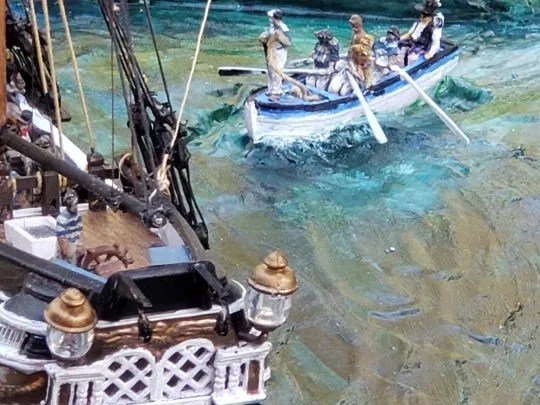
The davits are the last puzzle in the Black Falcon rework. They’re too close together, too short, and the tackle is missing. But they’re handsome pieces. Let’s not talk about the rest.

You may have seen my post about adding a different boat to the reworking of the Atlantis Black Falcon plastic model ship kit. The challenge lies in the size of the boat.

If you use the itty-bitty boat supplied in the kit (that’s it, just ahead of the boat with the crew in it), it fits aboard beautifully, but is laughably out of scale. The boat in the rework was kitbashed from boats from two other kits.  She looks to be of adequate size, but how to bring her aboard? And where to stow her?

Over the stern, of course! You can’t bring her inboard, and there be no law against hanging her outboard, is there now?

The two pieces that became the davits began life as supports for the mizzen chainwale of the ill-fated Soleil Royale. They were attached at one time, but somehow came off… it’s a long story.

Flipped 90 degrees, however, the length of the shorter arm almost exactly matches the height of the Black Falcon’s transom. And they’re handsome pieces – much better than what I was planning to fashion out of Popsicle sticks!

A piece of thin tan thread passes through the drilled-out hole in the block, supplied by the Soleil Royale, and ties in a simple knot on top. That simple knot is then tied against the bottom of the ersatz davit with another simple knot, this one on top of the davit so that the block is centered underneath.

They are too close together to accommodate the length of the boat, and are too short to keep her safely away from the stern windows when the wind blows, but let’s not talk about that. Neither should we talk about how difficult it must be to fish the boat lifts through those blocks, way out there at the ends of the davits. Nor shall we talk about where the tackle is to lift the boat. Duh. That’s what’s in those blue lockers!

The davits are the last puzzle to be solved in the reworking of the Black Falcon kit. There are no mysteries left to solve, beyond those things I foolishly omitted.

Tales of the Black Falcon is part of the John D Reinhart content family. Writer, illustrator, videographer, and accidental filmmaker — find the whole story at JohnDReinhart.com.

©2026 John D Reinhart/TalesOfTheBlackFalcon.com – all rights reserved
Make Great Grates

Need a scale grating for your model ship and don’t want to go mad? Plastic canvas from the craft store solves the problem for about two dollars and fifteen minutes of your time.

If you’re lazy like me, and you build model ships, and you need to cover a hole in your deck, you know how difficult it is to find a material for your gratings.

If you don’t know, your gratings are your wooden covers for some of the openings in your deck. You could have a solid wooden cover, or maybe a solid wooden hatch with hinges and a lifting ring. But, if you want to allow air and light through the hole, but not the occasional sailor, you install a wooden lattice work, called a grating.

Gratings are easy in large scale models: you simply assemble very small pieces of wood into a grid pattern. Or you could buy a lattice-work kit for your scale.

But scratchbuilding a lattice grating in 1/87th scale? It’s a road to madness.

However.

Plastic canvas. Roughly a hundred years ago, my ex-wife had this passion for making sculptural yarn works – puppy dogs, kitchen witches, toilet brush holders, etc. They were hideous. But, to provide the structure for the yarn, she bought tons of plastic canvas.

A hideously cute tissue box cover made of yard sewn over plastic canvas.

Plastic canvas is made of a slimy vinyl, and comes in a variety of different grid sizes, from tiny to huge, solely for the purpose of making hideously cute yarn and string… things.

It’s super cheap, and easy to find both online and at your local arts and crafts store.

And, in the smallest size, makes a nice grating.

Although hard to see, the grossly out of scale Atlantis Black Falcon staircase leads right to a cannon.

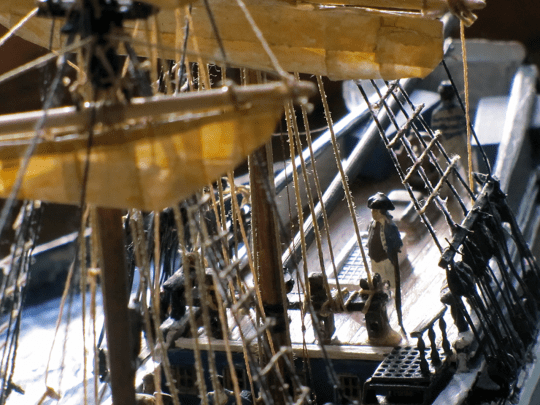
In this case, the original Black Falcon deck had a staircase that led you right down to a cannon. The staircase was supposed to be a ladder, but, due to molding limitations of the day, was filled in underneath, making it more of a staircase. Regardless, the thing was fantastically out of scale with the rest of the ship. Look at that tiny boat, lying over the grossly-out-of-scale grating. If the guy was scaled for the stairs, the holes in the grating would be a yard square. If he was scaled for the grating, the step risers would be, like, three inches. In either case, the lovely little boat is just wrong.

Bumping the ladder up to an appropriate size brought it down right on top of the gun – clearly an untenable situation.

A revised companion ladder is made of a 1/100 scale ladder from Heller's Soleil Royale and a plastic canvas grating.

Instead, our ship now has a little bridge over the gun. You can see the gun carriage sticking out under the bridge. It’s a little cramped for that gun crew, but with the open rungs of the ladder and the grating overhead, at least there’s some place for the gun’s smoke to go. Rather than build two ladders, which would be awkward but would replace the two staircases in the kit, I chose to eliminate the starboard ladder and modify the one to port.

Like the grating over the opening in the main deck, I used plastic canvas to simulate the lattice. It’s a trifle thick, but doesn’t detract from the overall appearance.

Just to complete the picture, the ladder, the little railing on the bridge, the pin rails, the deadeye blocks, and the bulkhead behind the ladder all came from Heller’s 1/100 scale Soleil Royale. That is a lovely kit, but so inaccurate – not just to the ship, but to history itself – as to be scarce worth the time and work to build it. Okay. I’m lazy.

And, yes, that is a splice in the main brace you see right above the cannon in the middle of the shot. But the Popsicle-stick decks look nice…

Tales of the Black Falcon is part of the John D Reinhart content family. Writer, illustrator, videographer, and accidental filmmaker — find the whole story at JohnDReinhart.com.

©2026 John D Reinhart/TalesOfTheBlackFalcon.com – all rights reserved