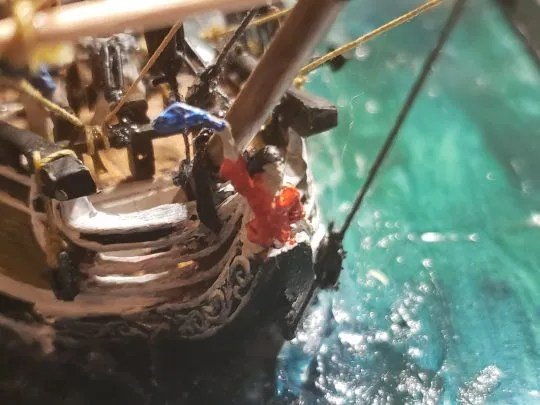
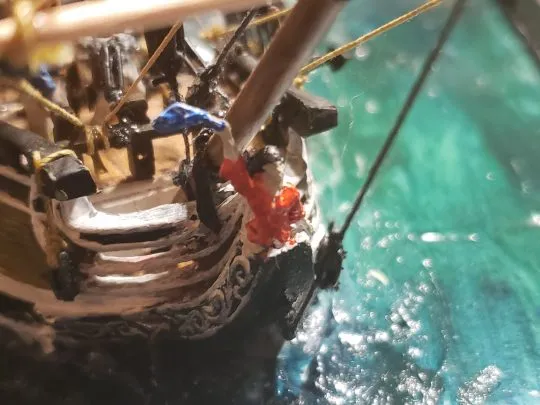
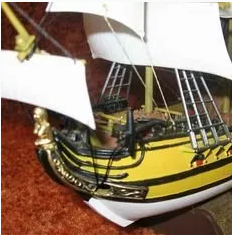
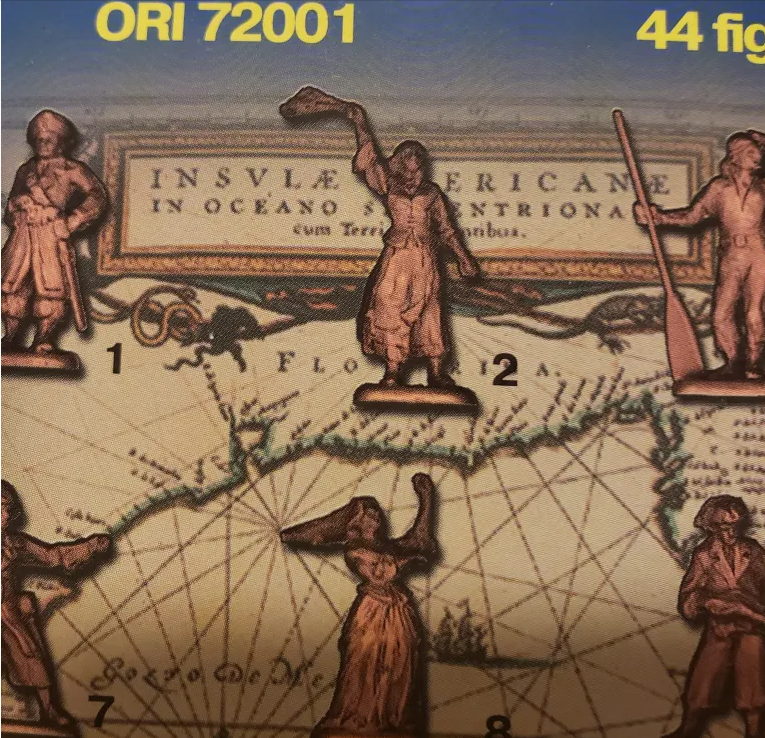
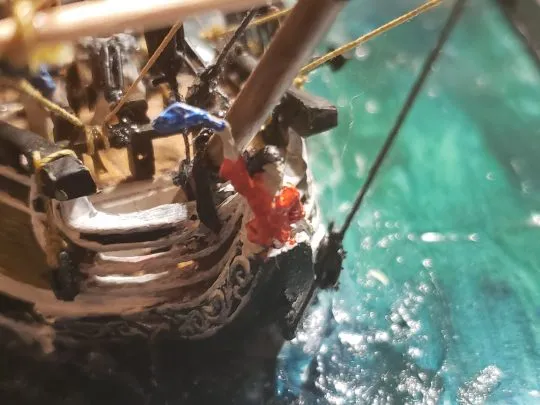
The Black Falcon’s original figurehead went missing. The Budget and Finance Committee made a replacement figurehead inadvisable. Woman Waving from the Orion Pirates set solved everything.
In reworking the Atlantis BlackFalcon plastic model ship kit, I had thought about making her into the KathrynB, the real hero of my novel The Diary of Phineas Caswell.
It’s vaguely ironic, because the KathrynB was based on the BlackFalcon, so you sort of get this dog chasing its tail kind of a thing… anyway, not the point.
Back in BlackFalcon’s day, sailors were most often a poor and illiterate lot. These chaps routinely traded in their freedom and safety in exchange for a solid three square meals a day by signing up to serve on His or Her majesty’s royal naval vessels. And that was a very tough gig.
Because they couldn’t read, they could tell their ships in port by the figurehead. As often as not, the figurehead symbolized the ship’s name.
Not so the BlackFalcon! If you were a teenage boy, the breasts on the naked figurehead were enough to make you shell out your $.98 in a hurry!
Oddly, the busty figurehead on my BlackFalcon was missing… no further questions, your honor.
The real Kathryn B behind the ship’s name in the novel was fictitiously a character’s mother, but in real life is my wife, so the busty naked wench was out anyway.
This girl came from a boxed set of English Pirates, Sea Warriors 18 Century from a Russian company called Orion. You get 44 folks in 22 different poses. Four of the 44 folks are actually a pair of very nice cannons, and another two are scary skeletons.
But there are six women in the set, two each of three poses. You get “Pirat Woman,” brandishing a sword and a dagger, “Lady Resisting Pirat” – she accompanies a fellow called “Pirat Pulling Lady’s Hair,” and you get “Woman Waving.” They are very nicely sculpted, with to s of detail and animation.
I hacked Woman Waving in half at the waist and mounted her upper works onto the plinth abandoned by the busty wench. A little bit of Squadron putty faired her hair into the bowsprit support, and she was aboard!
Tales of the Black Falcon is part of the John D Reinhart content family. Writer, illustrator, videographer, and accidental filmmaker — find the whole story at JohnDReinhart.com.
Chainwales kept the mast standing and gave Phineas Caswell his only refuge. Here’s what they are, why they matter, and how Popsicle sticks solved a problem the Soleil Royale couldn’t.
Chain whats? Chain wales, my friend. Although you’ll find many a seaside tourist trap hawking sailing ship models crafted by people who’ve never laid eyes upon a square rigged ship, or a ship, or quite probably the sea for that matter, featuring shrouds tied off straight to the hull, never since the year 1400 was there a masted sailing vessel that didn’t feature some degree of wale.
Ah, wales. Neither the country nor the seagoing mammals, wales, according to Chapman, are “the thickest strakes of wrought stuff in a vessel.” Thank you, Captain. That clears it up.
The outside of a ship’s hull was planked in a fore-and-aft direction with long timbers of a uniform thickness. A certain few timbers, however, were thicker, and more robust. These were called wales. Usually there was one down above the waterline, intended to fend off wayward boats. Another was up at the top of the side, intended as a steady rest platform for chaps with muskets. It was called the gunwale.
The masts were supported front and back by ropes called forestays and backstays. and from side to side by ropes call stays singularly, but when grouped together were called shrouds. The shrouds provided by far the highest percentage of support for the mast.
As I’m sure you know, the mast wasn’t fixed to the ship. There was truly no way to bolt it to the fabric of the ship. Instead, the mast was lowered using another vessel called a masting shear, through the ship’s decks, down and down until it rested on the keel. Wedges were driven in the deck holes through which it passed to hold it place, but they weren’t very strong, and could come out. The mast was held down against the keel by the shrouds.
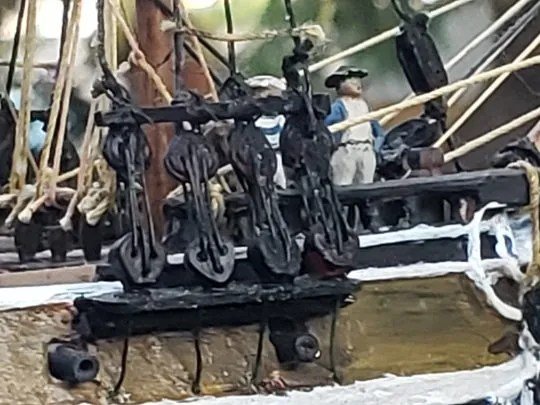
The shrouds stretched from the top – the maintop, foretop, etc – down to the side of the ship. To protect the ropes from the gunwale, a stout wooden plank extended from the hull as a standoff. This plank was called the chainwale.
And it was called the chainwale, often shortened to channel, because the ends of the individual stays in the shroud were chained to the hull to keep them from coming loose.
Man, that was a long way to get around to explaining that, just like the deck planking and the tops, Popsicle sticks once again provided the material for the Black Falcon‘s chainwales.
In my novel The Diary of Phineas Caswell, our eponymous young protagonist spends quite a bit of time sitting out on the mainmast chainwale, so it was important for me to create these correctly. Although it’s a circuitous way to sell a book, these chainwales provide a pleasant link between the fictitious plastic Black Falcon and the fictitious Kathryn B.
The chainwales molded into the Black Falcon’s sides were quite shallow – although that’s a subjective term as the model had no real scale – and, to make it easier both to mold and build, the chains were molded as solid triangles! It looked kinda cool, like those tract houses from the 50’s that had Dutch-style gingerbread to make them look more expensive. But it was wrong. Just wrong.
So, job number one was to sand them off. And that was quite a job.
At first I’d hoped to use the chainplates from the defunct Soleil Royale, but the hole spacing for the shrouds was all wrong, and the plastic was too brittle to work with. Plus, those things were huuuuuge compared to the tiny Black Falcon.
Instead, I used Popsicle sticks, cut in half lengthwise. They had the right amount of heft to hold up to the rigging that was to come.
So, I had a glorious plan to drill micro-sized holes near the outside edge of the wale, and then actually and accurately rig a shroud from the hull to the top. Ideally, the shroud would connect below the chainwale, pass up through the chainwale, through the deadeyes, up the top and over the mast, back down the other side, through the deadeyes, the other chainwale, and back into the hull. And I’m certain there is a modeler that has done that.
Not this one.
I drilled the holes near the outer rim of the wale, but, given my mediocre attention span, didn’t quite make them straight. Rats. The deadeye assemblies, you can read about those here, went on instead, eyeballed, glued either into the hole, or directly to the chainwale where the hole ought to have been.
A tiny stretch of 28 gauge wire, jabbed into a pre-drilled hole in the hull, provides the chain. They’re bent underneath the wale, and come up close to where they would realistically extend to the deadeye.
Of course, the plastic Black Falcon had gross shroud/deadeye combo things that fit into a notch in the chainwale, and, man did that make life easy!
These may look more accurate than the plastic wales, and they may be somewhat more accurate. Most important for me, of course, is that they are wide enough for fictitious Phineas to hide away upon. Oh, wait, that was the Kathryn B…
Tales of the Black Falcon is part of the John D Reinhart content family. Writer, illustrator, videographer, and accidental filmmaker — find the whole story at JohnDReinhart.com.
The Black Falcon’s transom was flat as a board. Phineas Caswell needed stern windows. A trip to the Lego Store in Glendale solved both problems for about three dollars.
The transom on the original Black Falcon is flat like nobody’s business. Flat, like the design money for designing the kit ran out immediately aft of the ship’s wheel.
In my novel The Diary of Phineas Caswell, the 12-year-old protagonist spends quite a bit of time in the aft cabin of the Kathryn B, a merchant brig rather based on Aurora’s Black Falcon model kit. Except that the Kathryn B had big windows across her stern, not the boarded up, sterile transom of the Black Falcon.
One evening I found myself in the Lego Store in the Glendale Galleria, a massive, three-story mall built in a time when those were the wave of the future, rather than the brick-and-mortar reminders of who we once were.
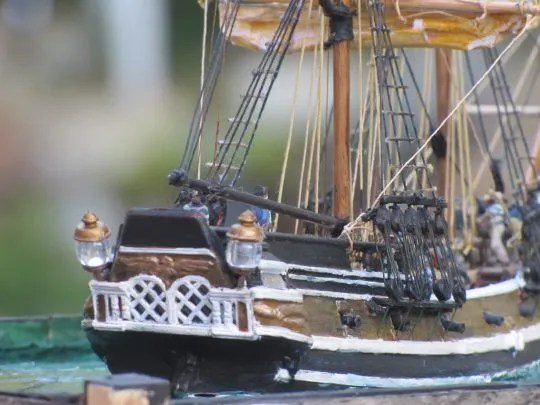
In that Lego store, you could buy oodles of individual parts. I picked up a tub of their little gold-colored castle windows, thinking that someday, someday I would find a use for them.
Yes, they’re ugly, and a little cockeyed. Kind of adds to the charm? Maybe?
In the day, say the early 1700’s, plate glass was virtually non-existent. Glass that was affordable for shipwrights, shop owners, and the small tavern came in little shards and pieces. Thus, the stern windows would have been mullioned affairs. Even so, each of the panes in the Black Falcon‘s windows would be around 18×18 inches – not cheap.
As long as we’re looking astern, the corner pieces hide my crude craftsmanship at the corners of the original transom. They come from the ends of a balcony on the Soleil Royale.
The stern lanterns came from a Lindberg’s Captain Kidd Pirate Ship kit. If you hack away the brown plastic lantern lens and replace it with a craft bead, it looks pretty cool. Those hide the crummy craftsmanship of the balconies.
So, there you have it. A super easy, super quick modification, all thanks to Legos. Thanks, Lego!
Tales of the Black Falcon is part of the John D Reinhart content family. Writer, illustrator, videographer, and accidental filmmaker — find the whole story at JohnDReinhart.com.
The Kathryn B is the true hero of The Diary of Phineas Caswell. Here’s what she looks like — deck plan, sail plan, and the creative problem of making a 70-foot model into a 100-foot ship.
In my efforts to set the stage for my upcoming book, The Diary of Phineas Caswell, I’ve been reworking the lovely Black Falcon plastic pirate ship kit ito both look like the Kathryn B, the true hero of the novel, and to accommodate 1/87 scale figures.
In the novel, Kathryn B is about 100 feet long. The Black Falcon, my copy was made by a Czech company called Smer, works out to about 70. A wee bit of stretching was required to make Kathryn B out of Black Falcon.
So, what to do, what to do? Well, instead of hacking the model ship’s hull through the midsection and fabricating 30 scale feet of plastic with the proper tumblehome and wales and internal ribbing, I decided just to make a picture of what she would look like. I hope you enjoy them, and that they inspire to write a novel, too!
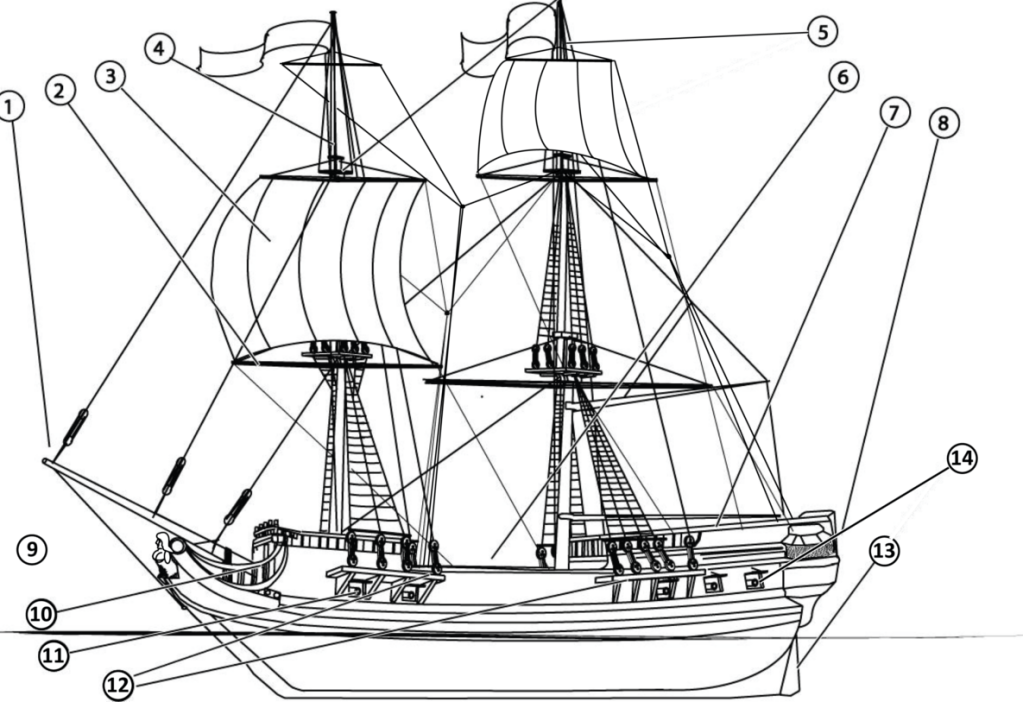
This little tiny who’s-who of ship parts shows you pretty much where I added length to her. There’s about ten feet forward of the foremast. Looking at it now, it looks kind of weird. And then there’s another twenty feet forward of the mainmast. And no guns in the waist. It’s important to the story, but looks a little odd in the light of time.
A cool thing about sailing ships, however, is that, although they were designed to general standards, no two were ever alike. And shipwrights tried just about every combination of deck length and masting plan and sail plan to come up with something efficient. So, an odd looking duck like the Kathryn B could very well have sailed the seas. Just not attractively…
Tales of the Black Falcon is part of the John D Reinhart content family. Writer, illustrator, videographer, and accidental filmmaker — find the whole story at JohnDReinhart.com.