A Fanciful, Cranky Queen

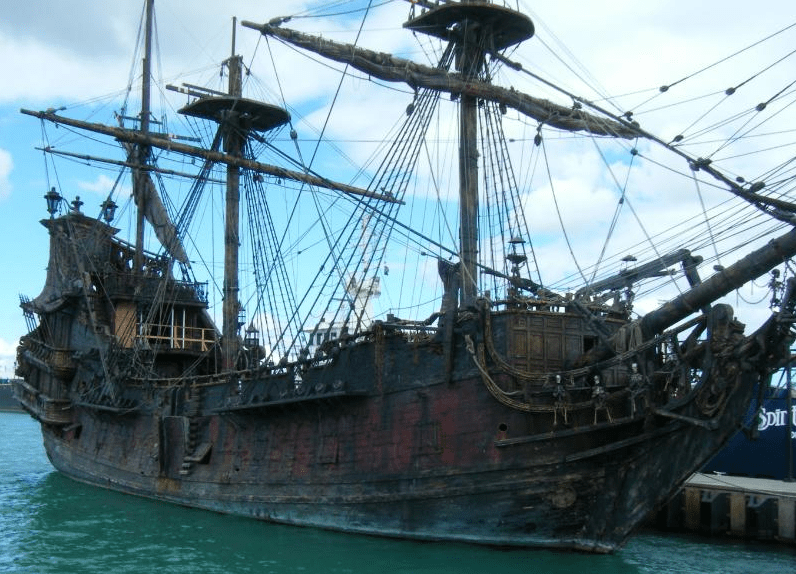
She’s all skeletons and gunports and romance. She’s also top-heavy, diesel-powered, and would tip over in a stiff breeze. A cranky Queen, that one.

I’ve been looking for reasonable images of Blackbeard’s Queen Anne’s Revenge, and came across this cool photo. It’s labeled “Queen Anne’s Revenge Pirates of the Caribbean,” but I don’t think she’s related to either the real ship or those Disney movies.

Ah, but she’s a beauty, isn’t she? All carved and skeletons, and, wait, what’s with the piece of plywood there up there on the quarterdeck, just inside the railing of, what are those, 2x4s? Clearly a work in progress.

One of the things I find most interesting about sailing ships is how carefully they were designed to be symmetrical. Aside from the pure aesthetics of design, there were very serious reasons behind balancing a ship.

First, a ship needed balance from port to starboard, left to right. If one side was heavier than the other, she’d be difficult to steer, and could lay right over if the wind got too high.

And a ship needed to be balanced from fore to aft, front to the back. If she was heavy in the bow, for example, she’d plow nose-down through the waves when the wind got up, making her difficult to steer, and potentially flooding her forward parts. She’d be known as a wet ship on the best of days.

If she were down by the stern she’d be nearly impossible to steer in any kind of wind, and would almost sail sideways in anything but a stern-on breeze.

Captains could manage a ship’s fore-and-aft trim a little bit by shifting cargo in the hold forward or backward, but that wouldn’t compensate for a bad design.

A ship also needed to be balanced from the keel to the truck, from bottom to the top. Too much weight below the waterline and she would be sluggish and susceptible to getting swamped when the wind got up. Too much weight above the waterline and she might just tip over.

For example, the Swedish ship Vasa was so top heavy that she sailed only 1400 yards on her maiden voyage in 1628 before the wind laid her over on her beam ends and she sank. Sadly, with all hands.
 

So, let us imagine that  Queen Anne’s Revenge was actually built as pictured. First, let’s remember that Queen Anne’s Revenge is the name Blackbeard gave to the French slaver La Concorde, after he captured her.

According to National Geographic, he took her specifically because she was a slaver, and her crew was depleted by disease, and only half her gunports had cannons behind them. How he could have known all this in advance of meeting her is a little mystifying, but okay.

So he captures her and sets about setting her up as the flagship of his pirate fleet. This would have been around 1718, so the only power tools available were those that you powered yourself.

Perhaps those are all real skeletons, wired together and mounted out on the forepeak. That’s really creepy, and would take an immense amount of medical work and craftsmanship to get them to stay together, but it might have been easier to accomplish than carving them out of wood.  As our Mr. Beard had the Queen for less than a year, he must have had quite a contingent of artists and craftsmen in his crew. 

But that’s another story.

Keeping in mind that fore-and-aft symmetry we were talking about, it seems as if this Queen’s high, high stern would be heavy, and might push her bow right up out of the water. She sits level in this photograph because the heavy modern diesel engine must be placed as far forward as possible to balance her out.

She is a modern craft, after all, and clearly built to a shallow draft – which means she doesn’t sit very low in the water. That’s a challenge, as she appears to be pierced for at least 18 heavy cannons, all above the waterline of course, and those massive platforms at the top of the masts undoubtedly provide support for topmasts, and possibly even gallant masts above those. All those sails and guns and woodwork so far above the sea, and scant little hull to balance it below.

Yes, without the weight of those diesel engines below deck, she has very little compensation against the weight of her masts and sails, and the pressure of the winds. Sadly, she would be very difficult to sail on a nice day, and would find herself extremely challenged to stay upright on anything more than a slight breeze. 

Sailors would call her a crank ship – a right cranky Queen, that one.
 
But, she truly captures the romance of the pirates, doesn’t she? Skeletons and gunports and lanterns and those canvas awnings over the quarter galleries? She is a beauty.

And, was you with your telescope to espy a ship like that, perhaps a little better balanced, bearing down upon you from wind’ard with every sail drawing and a black flag at the peak, you’d find yourself having to make some very difficult decisions very quickly!

As a dramatic piece of art, she checks all the boxes.

As a realistic reference for Queen Anne’s Revenge, we might have to take a pass.

Ah, but she is fun to look at, isn’t she?

Related Reads

Tales of the Black Falcon is part of the John D. Reinhart content family. Writer, illustrator, videographer, and accidental filmmaker — find the whole story at JohnDReinhart.com.

©2026 John D Reinhart/TalesOfTheBlackFalcon.com – all rights reserved
Pity the Poor Marin Francais

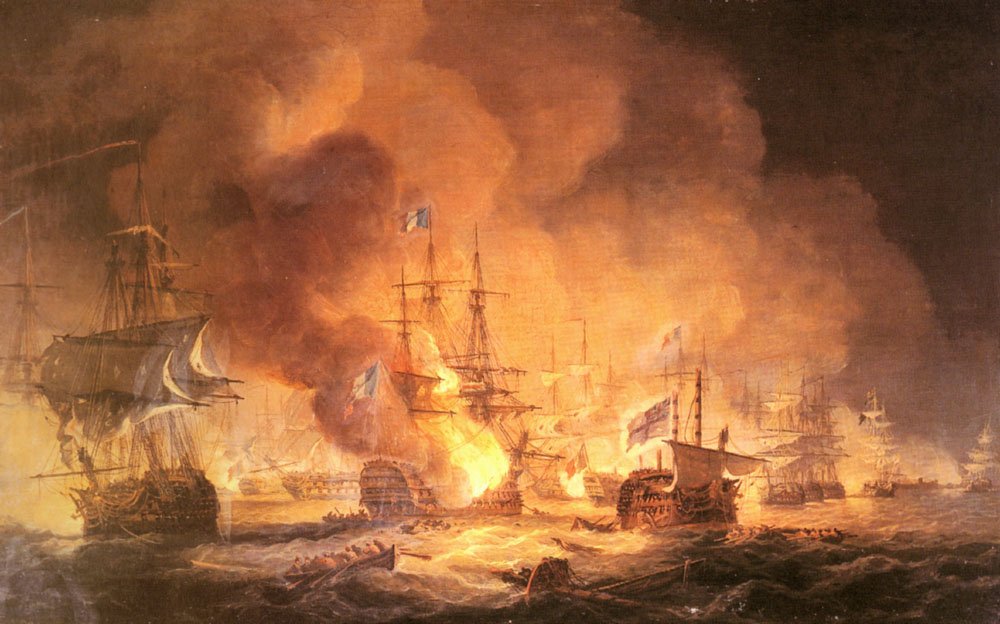
The explosion of L’Orient at the Battle of the Nile killed a thousand men in an instant. Here’s who they were — and why they had no choice about being there.

English naval history is replete with heroes who rose from the lowliest gundeck position to command a king’s ship. The French not so much.

I’ve been thinking about the explosion of L’Orient at Battle of the Nile. During that battle, the massive 118-gun ship of the line, the flagship of the French Mediterranean Fleet, famously blew up when her 40-ton stockpile of powder caught fire. The explosion was so loud it was heard in Cairo, 150 miles away. It was an explosion so robust that it caused the battle raging between 24 ships of the line to pause for ten minutes, the ships’ crews stunned and awestruck.

L’Orient housed 1,079 officers and men. Although some of her crew might have been ashore, most would have been aboard when the battle began.

It’s those guys, all of whom perished in the blink of an eye, that give me pause. Brothers and sons, all but the officers unmarried, guys in the prime of their lives, blown to dust.

To be sure, life at sea was hard enough for any sailorman. Imagine living in a world forever damp, forever in motion, and forever filled with danger from every direction.

The sea was always around you, below you, trying to find a way in between the hull’s wooden planking. Water that crept in was pumped out daily

The wooden walls of your world were constantly drying out, becoming either soft or brittle. Wood rot was always a major concern for the ship’s boatswain and carpenter, officer and captain. The ship was drying to death underneath the tar that kept out the sea.

The wind forever tried to push your ship’s yards and masts over the side. Rigging was constantly renewed, for it became frayed and weakened by the efforts of the wind and sun and sea.

Fire was an ever-present hazard. A lantern overturned, a candle spilled, and your home would become a blazing inferno. Look at L’Orient.

The food was dreadful – a piece of salted beef that had to be boiled to become edible. A stew made up of oatmeal and lard, sometimes dried peas if you were lucky. Biscuits so hard you could break your teeth if you didn’t soak them, and often packed up with wriggling weevils. Flat beer because the drinking water was so bad. And watered rum, called grog, so that you wouldn’t complain.

Justice in the onboard society was at the whim of the captain and his officers. Most captains were decent, some weren’t. Captain Bligh, aboard HMS Bounty, was put over the side in 1789 by a mutinous crew. Captain Pigot, aboard HMS Hermione, was brutally hacked apart by his crew in 1797.

Yet it was the poor sailorman, crawling aloft in a gale, standing fast in a gunroom filled with fire and smoke and flying splinters, hauling at the windless on an icy deck, that kept these ships not only afloat, but powerful weapons in the war between nations.

Your English sailorman was conscripted, dragged from the pub or right off the street by a naval press gang. If he worked hard and kept his head and remained decent, however, he might make his way from, say, the gun deck to the quarterdeck. An intelligent, resourceful man could get promoted from common sailor to midshipman, accepting the king’s commission.

Your French sailorman was likewise conscripted. By law, he was to be unmarried, between the ages of 18 and 25, uneducated, and was pressed into service often against his will.

But the Marin francais, the French sailorman, had no opportunity to change his lot. By French law, officers were only selected from royalty. To even become an Elève de la Marine, or midshipman, you had to prove your royal heritage.

Your Marin francais was forever kept on the gundeck. He might move up in the ratings, become a gunner’s mate, for example. But he would never become an officer. You can imagine that his motivation would have been to survive, to get home, but not to innovate.

I come back to the thousand or so chaps aboard L’Orient, then. Like the galley slaves of old, their choice to be aboard that ship at that point in time was entirely out of their control.

What a remarkable, and remarkably tragic, event.

There are many, many fascinating things about the loss of L’Orient, which we’ll look into another time.

Related Reads

Tales of the Black Falcon is part of the John D. Reinhart content family. Writer, illustrator, videographer, and accidental filmmaker — find the whole story at JohnDReinhart.com.

©2026 John D Reinhart/TalesOfTheBlackFalcon.com – all rights reserved
Casting Scallawags

Meet the cast: a determined British artillery officer, a Hong Kong cowboy with minimal flash, and a pirate who swaggered into the studio and got the job on the spot. Tales of the Black Falcon is casting — and nobody needs flexible joints.

When your actors are only an inch tall, their resumes actually don’t matter that much.

I’m casting characters for a video series, you see… or, you will see… about a trio of inch-tall fellows building a ship. No acting experience necessary, no ship-building skills. Heck, you don’t even need flexible joints!

There are three characters – Major Sir Addison St. James Lord Hildebrand Mornington III (the Major), Lester Howdie, and Foretop Jake Callop.

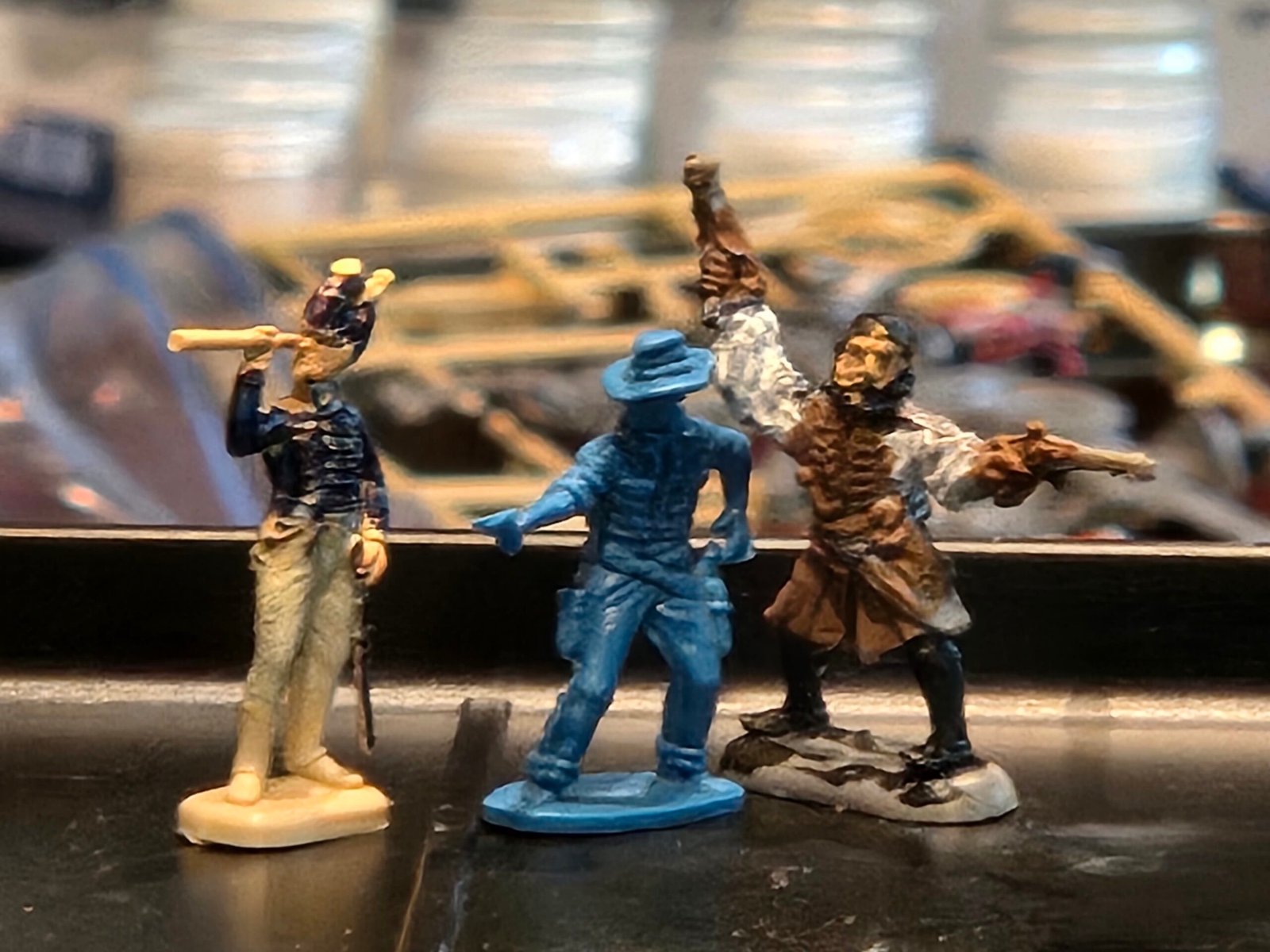
The challenge in finding 1/72 figures lies in discovering guys that aren’t doing anything. The Major in the picture comes from a Italeri British Artillery 1805 set (6041). He didn’t make the cut, sadly. Although a nice looking fellow with a good start on the paint, that spyglass forever stuck to his face rather limits his expressive opportunities.

Instead, the Major will be played by a fellow two spots over on the same sprue. Instead of a spyglass, he’s holding a slow match, waiting to apply it to the fuze of a waiting gun. He carries a look of determination and you can see his face. That’s a big step.

Lester had yet to be painted at the time of the picture. He comes from Hong Kong via a knockoff of the Airfix Cowboys set (A01707). I think. I found him in a baggie filled with both cowboys and Indians. He had the least flash of all the guys in the bag (a sign of that Hong Kong heritage) and that cool, I’m about to draw my other pistol stance.

Foretop is my favorite of the bunch – I knew he’d have the job the second he swaggered into the studio. He’s the least barbaric member of the seadogs featured in Mars Figures’ Pirates of the Caribbean set (MS72009). He had a ton of flash, and his base was none too flat. But that wild, wide open face sealed the deal.

These guys are the heroes of the upcoming Tales of the Black Falcon video series. They’ll stop-motion their way through the building of the Black Falcon plastic model ship kit.

We’ll talk more about this fabled sailing ship in another post, but the kit we’re building was produced by Atlantis Models several years ago. I know what you’re thinking – gasp, this is a priceless collector’s item! How could you?!?

First, I’m not a collector. Second, you can get the same kit from Amazon* today, produced by the Czech company Smer. It’ll run you $17. Hobbylinc.com also sells the Atlantis version for $24, but it’s on backorder.

Finally, this ship is just a knockoff the original 1962 Aurora kit. No tears. No remorse.

Ah, but for all that, she’s a lovely little tub.

Now that we have the cast assembled, they’ll go into wardrobe to get ready for their big-screen debut.

Follow along as we assemble the video studio, build the ship, and bring our miniature adventure to life!

*As an Amazon affiliate, I earn from each qualifying purchase. Thank you for supporting Tales of the Black Falcon.

lated Reads

Tales of the Black Falcon is part of the John D. Reinhart content family. Writer, illustrator, videographer, and accidental filmmaker — find the whole story at JohnDReinhart.com.

©2026 John D Reinhart/TalesOfTheBlackFalcon.com – all rights reserved