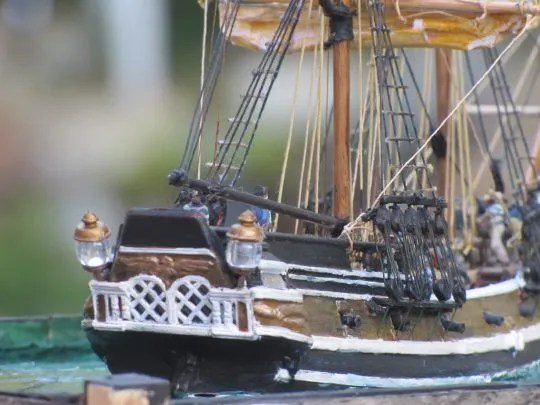
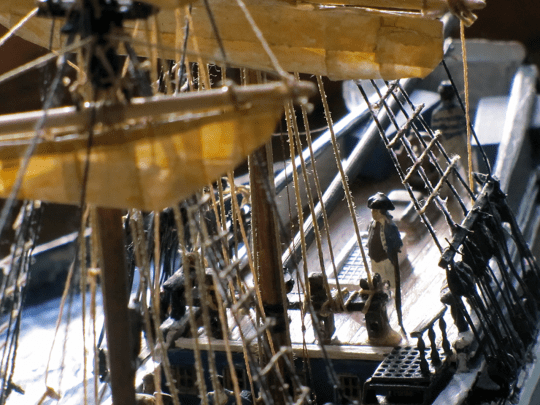
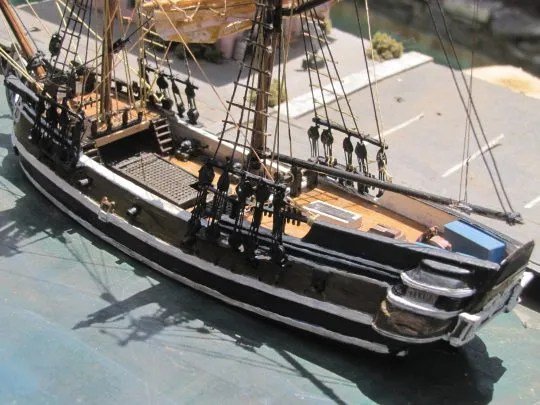
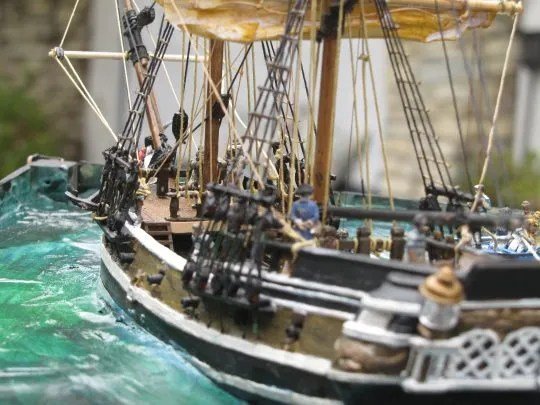
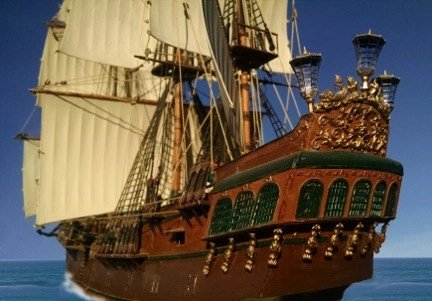
The Black Falcon’s transom was flat as a board. Phineas Caswell needed stern windows. A trip to the Lego Store in Glendale solved both problems for about three dollars.
The transom on the original Black Falcon is flat like nobody’s business. Flat, like the design money for designing the kit ran out immediately aft of the ship’s wheel.
In my novel The Diary of Phineas Caswell, the 12-year-old protagonist spends quite a bit of time in the aft cabin of the Kathryn B, a merchant brig rather based on Aurora’s Black Falcon model kit. Except that the Kathryn B had big windows across her stern, not the boarded up, sterile transom of the Black Falcon.
One evening I found myself in the Lego Store in the Glendale Galleria, a massive, three-story mall built in a time when those were the wave of the future, rather than the brick-and-mortar reminders of who we once were.
In that Lego store, you could buy oodles of individual parts. I picked up a tub of their little gold-colored castle windows, thinking that someday, someday I would find a use for them.
Yes, they’re ugly, and a little cockeyed. Kind of adds to the charm? Maybe?
In the day, say the early 1700’s, plate glass was virtually non-existent. Glass that was affordable for shipwrights, shop owners, and the small tavern came in little shards and pieces. Thus, the stern windows would have been mullioned affairs. Even so, each of the panes in the Black Falcon‘s windows would be around 18×18 inches – not cheap.
As long as we’re looking astern, the corner pieces hide my crude craftsmanship at the corners of the original transom. They come from the ends of a balcony on the Soleil Royale.
The stern lanterns came from a Lindberg’s Captain Kidd Pirate Ship kit. If you hack away the brown plastic lantern lens and replace it with a craft bead, it looks pretty cool. Those hide the crummy craftsmanship of the balconies.
So, there you have it. A super easy, super quick modification, all thanks to Legos. Thanks, Lego!
Tales of the Black Falcon is part of the John D Reinhart content family. Writer, illustrator, videographer, and accidental filmmaker — find the whole story at JohnDReinhart.com.
Need a scale grating for your model ship and don’t want to go mad? Plastic canvas from the craft store solves the problem for about two dollars and fifteen minutes of your time.
If you’re lazy like me, and you build model ships, and you need to cover a hole in your deck, you know how difficult it is to find a material for your gratings.
If you don’t know, your gratings are your wooden covers for some of the openings in your deck. You could have a solid wooden cover, or maybe a solid wooden hatch with hinges and a lifting ring. But, if you want to allow air and light through the hole, but not the occasional sailor, you install a wooden lattice work, called a grating.
Gratings are easy in large scale models: you simply assemble very small pieces of wood into a grid pattern. Or you could buy a lattice-work kit for your scale.
But scratchbuilding a lattice grating in 1/87th scale? It’s a road to madness.
However.
Plastic canvas. Roughly a hundred years ago, my ex-wife had this passion for making sculptural yarn works – puppy dogs, kitchen witches, toilet brush holders, etc. They were hideous. But, to provide the structure for the yarn, she bought tons of plastic canvas.
Plastic canvas is made of a slimy vinyl, and comes in a variety of different grid sizes, from tiny to huge, solely for the purpose of making hideously cute yarn and string… things.
It’s super cheap, and easy to find both online and at your local arts and crafts store.
And, in the smallest size, makes a nice grating.
In this case, the original Black Falcon deck had a staircase that led you right down to a cannon. The staircase was supposed to be a ladder, but, due to molding limitations of the day, was filled in underneath, making it more of a staircase. Regardless, the thing was fantastically out of scale with the rest of the ship. Look at that tiny boat, lying over the grossly-out-of-scale grating. If the guy was scaled for the stairs, the holes in the grating would be a yard square. If he was scaled for the grating, the step risers would be, like, three inches. In either case, the lovely little boat is just wrong.
Bumping the ladder up to an appropriate size brought it down right on top of the gun – clearly an untenable situation.
Instead, our ship now has a little bridge over the gun. You can see the gun carriage sticking out under the bridge. It’s a little cramped for that gun crew, but with the open rungs of the ladder and the grating overhead, at least there’s some place for the gun’s smoke to go. Rather than build two ladders, which would be awkward but would replace the two staircases in the kit, I chose to eliminate the starboard ladder and modify the one to port.
Like the grating over the opening in the main deck, I used plastic canvas to simulate the lattice. It’s a trifle thick, but doesn’t detract from the overall appearance.
Just to complete the picture, the ladder, the little railing on the bridge, the pin rails, the deadeye blocks, and the bulkhead behind the ladder all came from Heller’s 1/100 scale Soleil Royale. That is a lovely kit, but so inaccurate – not just to the ship, but to history itself – as to be scarce worth the time and work to build it. Okay. I’m lazy.
And, yes, that is a splice in the main brace you see right above the cannon in the middle of the shot. But the Popsicle-stick decks look nice…
Tales of the Black Falcon is part of the John D Reinhart content family. Writer, illustrator, videographer, and accidental filmmaker — find the whole story at JohnDReinhart.com.
Coffee stir sticks, CA glue, wood stain, and an unreasonable amount of sanding. Here’s how to replace the Black Falcon’s plastic deck with a real wooden one that actually looks like a ship.
The Black Falcon model kit comes with an immensely busy plastic deck. It’s all one piece, from stem to stern, and features every possible piece of furniture, from pin rails to coils of rope, already molded onto it. The only things missing are the guns. Because it’s a model kit from the early 1960’s, the deck seams are horrifically wide, and astonishingly deep. Okay, that’s a little over the top, but they’re not very realistic.
I never intended to model wooden decks, but stumbled upon this method, and realized it just might work.
All you need for this project is a few hundred coffee stir-sticks, some sandpaper, and a bottle of CA (cyano-acrylic, or super) glue. Oh, and some wood stain.
You’ll want the coffee stir-sticks instead of Popsicle sticks because they’re thinner, narrower, and longer. The thinness is more to scale for the Black Falcon. You’ll appreciate the narrowness in a moment. And the length makes it easy to build the correct length decks.
The process is stunningly easy: glue two sticks together, flat to flat. Be careful with the glue: put three dots on one piece, each an inch from the other. Put the second stick on top and hold them firmly together for the full thirty seconds, until the glue sets.
And that’s it. Add another stick, and then another, until you’ve built the width of the deck. Well, that’s not quite it.
Measurements
The Black Falcon has an opening in the main deck. Flip the plastic deck over and measure the length and width of the opening. Measure the distance between the edge of the deck and the side of the opening (A). Measure the distance between the forward edge of the deck and the forward edge of the opening (B). And, measure the distance from the aft end of the opening to the aft end of the deck (C). As long as we’re at it, measure the length of the entire deck (D). It seems complex, but it’s really not.
Assembly
So, make a raft of sticks that’s as wide as measurement A and as long as measurement D. Now make another one just like it. These are the side pieces.
Now, make a mini-raft out of sticks that are as long as measurement B and the width of the opening.
Now make a mini-raft the same length as measurement C and the same width as the opening.
Match the end of one mini-raft to one end of a side piece, and glue it on. Match the end of the other mini-raft to the other end of the side piece and glue that on. Now glue the other side piece to the two mini-rafts.
Do the same thing for the skylight in the halfdeck.
To get the sides of your new deck into the right shape, set the old plastic deck on top of your beautiful, genuine wooden deck. Match the openings, and use a Sharpie to draw the plastic outline onto the wood.
Sanding
Time to start sanding. And sanding. And sanding. Sand the sides first, to achieve the right shape. You’ll break off pieces of the deck as you go. Not to worry. Just glue them back on.
Now it’s time to sand the top of the deck. Be aggressive here. You want to get the deck absolutely smooth, eliminating the rises and pits between the sticks. Plus, you want to sand off the wax coating on the sticks.
When you’re done sanding, you have a gorgeous wooden deck to make the Black Falcon even more beautiful. However.
However, your deck is monstrously thick. Like three scale feet thick! Thank goodness we’re using skinny little coffee stir sticks – Popsicle sticks would make them around 5 feet thick!
You can fix it in a couple of ways. One way is to put a bulkhead at the ends of the deck. This works great for the forward end of the halfdeck and aft end of the foredeck.
But it won’t work for the after end of the halfdeck because of the rakish angle of the transom.
And, if you choose as I did to leave the space under the foredeck open, you’ll need to lose some thickness.
To hide the hideousness, aggressively sand the underside of the deck. Aggressive, so that it approaches a scale thickness. When you start to wonder if the coffee stir sticks can withstand much more abuse, it’s time to stop. I covered the remaining thickness with a simple wooden batten.
Coloration
Your decks now have a lovely offwhite color, which is very probably accurate if you’re modeling a navy ship: they holystoned their decks daily to keep them clean and to give the huge crew something to do.
But the Black Falcon be a pirate ship, don’tcha see?, so she probably didn’t get that much care. I stained mine with some old wood stain I found in the paint cabinet: go easy as a little goes a long way.
Furniture
Here’s where things get a tad dicey. Some of the features on Black Falcon‘s deck are simply useless: those boxes around the base of the masts, for instance. Those are meant to be pin rails, but it was too costly to make them separate parts, so they became planter boxes.
But some of the details are cool, like that sliding hatch on the quarterdeck, and that nice hatch out on the foredeck. Those I cut from the plastic deck and sanded down until they could sit flat on the wood deck.
The box that supports the ship’s wheel is not right, but looks kind of cool back there on the quarterdeck. I stole that, too.
Oh, and there are two big issues you’ll have to deal with. They’re on either side of the wheel. The plastic deck has a sort of flange molded there, but that’s so wrong as to be illegal. However, the flanges covered the space left open by the molding for the quarter gallery roofs.
I found those cool blue lockers in the Soleil Royale kit, and the problem was solved.
If you’re the patient type, you could drill out the windows in the skylight and steal that, too. I’m not, so I made my own out of coffee stir stick pieces and the top of the Soleil Royale’s chicken coop.
The Fit
As you can image, the sides of the Black Falcon are grooved to handle a deck that’s 1/16 of an inch thick. Ours is considerably more robust.
The original kit has you glue the hull halves together, and then fly the deck in from above. It’s not for the faint of heart, as you have to seriously pry the after ends of the hull quite a ways to get it to fit.
Our new decks don’t quite live in that airspace. No, we need to do it the very hard way.
First, don’t glue the hull halves together. If yours is already in that state, you could pry them apart, cut them apart, or, as I did, opt for a waterline model.
Shear off, sand down, and otherwise remove most of the alignment pins and such on the inside of the hull halves. I say most, because you need to leave yourself some degree of guidance for the location of our new deck.
Sand and sand and sand some more, until the fit is really very good. Temporarily tack each deck to the starboard hull, and then test fit the port side. It won’t fit, because nothing ever does on the first try.
But keep going, sanding and sanding, and eventually you’ll get a good fit. Permanently stick the decks to the starboard side, and then attach the port side.
And you’re done! Oh, she’s a beauty, eh, mate?
Tales of the Black Falcon is part of the John D Reinhart content family. Writer, illustrator, videographer, and accidental filmmaker — find the whole story at JohnDReinhart.com.
A terrible modeler with great ideas and no patience converts the old Aurora Black Falcon kit into something worth sailing. This is how that started — and why it never really stopped.
Now, before you say anything about the size of the deadeyes or the curious backdrop, take a moment and look at the picture. Feel the romance of the little Black Falcon, the pseudo-scaled plastic model sailing ship. Think about the old Aurora kit for a minute.
If you don’t know anything about the old Aurora kit, or the Smer kit, or the Polar Lights kit, or the new Atlantis kit – like her subject, the model Black Falcon has traveled quite a bit herself – that’s okay. Look her up online, and you’ll see how simple and oddly scaled she is. How thick those shrouds are, and what’s up with those triangular shapes at the masthead? What are those things?
If you know about the model kit, you’ll know that she was never assigned an actual scale, because she hailed from the days when the scale of the model was determined by the size of the box into which it would fit. Even by that standard, however, the model kit was grossly out of scale with itself: the person who would match the steps on the ladders would easily fall between the ratlines, the cannons would be taller than he was, and he’d never reach the spokes on the wheel. Those odd little rounded doorways on the forward bulkhead. For whom were those intended? Hobbits?
Beyond those goofy mastheads and odd doors, there were enormous bollards molded onto the deck, along with the occasional coiled rope. And the pinrails for each of the masts were turned into odd boxes, like planters out of which grew the mast.
For all that she was a lovely ship, with smooth underwater lines and a distinctly romantic shape. The underwater shape is too shallow for a ship of her length, but, hey, right?
I have loved that shape since the mid-1960’s, when I first found her for $.98 at the corner dime store. Who cared about the gross scaling and the clumsy molding. She was a ship, with guns! But no matter what size sailor I’ve tried to fit aboard, they’ve all clashed with something: the guns are too small, or the steps are too small. And, regardless, those molded ratlines are just gross.
So, one evening, I realized that I could use Popsicle sticks and dowels to make a better mast. It sounds dumb, but it’s true. And I did. And it didn’t stop there. A real wooden deck. Clear windows. Correct ladders…the list went on and on. Goes on and on, for I’ve not finished with her yet. Ratlines, deadeyes, skylight, even the figurehead is different.
This blog is about that process, the conversion of the old, oddly scaled plastic Black Falcon into a ship that could reasonably fit a 1/87 HO scaled crew. Together we’ll learn how to make the many things that go into scratchbuilding a sailing ship from a plastic model kit.
A couple of admissions. That picture is of a modification of Heller’s 1/100th scale Soleil Royale, a 104-gun ship of the line from the late 1600’s. Oh, she’s a lovely kit: enormous vacu-formed sails, a hundred guns, blocks and yards and carvings galore. But, she, too, is a grossly inaccurate model. Silly things like comically inaccurate cannons, and beautifully-shaped boats with utterly smooth hulls. Things so bad that I couldn’t see putting any more effort into her. I literally abandoned ship, choosing in desperation to cut her down to a 50-gun razee.
Navies that found themselves straddled with an out-of-date, over-gunned ship of the line sometimes sheared off the upper decks and works to make them sail better and more efficient. The result was referred to as a razee. Hey, Naval History! Who knew?
Anyway, that project went into the trash because her shape didn’t lend itself to anything that would work, and it was far more difficult than I had patience for. Plus she listed to starboard in the pool! But I saved a bunch of her pieces, and some of those are used in the Black Falcon.
One more word about nautical history: evolutionary. No single piece of sailing ship technology was produced in its final form right out of the gate. Just like life, the structure of a ship, her rigging, her sails, her various technical bits, all changed and refined over time. That means that, for a rather generic ship like the Black Falcon, there can be no exact representation of how she looked on a specific day. Be free! Have fun!
Okay, I must tell you the truth: I’m a terrible modeler. Really bad. I’m a really great artist, with a superb vision, but I have no patience. I don’t plan things out. I’m sloppy. I’m a lousy knot-tier. I choose expediency over accuracy because I have no patience. And I’m an awful gluer. Sloppy Joes are my go-to.
You see, I’m a writer. A romantic. A would-be once-upon-a-time sailor trying to get back to the sea. I’m just not a very good modeler.
But the ideas you’ll find here, however poorly executed, are good, and I hope you find them useful.
There, I said it.
Tales of the Black Falcon is part of the John D Reinhart content family. Writer, illustrator, videographer, and accidental filmmaker — find the whole story at JohnDReinhart.com.
The Kathryn B is the true hero of The Diary of Phineas Caswell. Here’s what she looks like — deck plan, sail plan, and the creative problem of making a 70-foot model into a 100-foot ship.
In my efforts to set the stage for my upcoming book, The Diary of Phineas Caswell, I’ve been reworking the lovely Black Falcon plastic pirate ship kit ito both look like the Kathryn B, the true hero of the novel, and to accommodate 1/87 scale figures.
In the novel, Kathryn B is about 100 feet long. The Black Falcon, my copy was made by a Czech company called Smer, works out to about 70. A wee bit of stretching was required to make Kathryn B out of Black Falcon.
So, what to do, what to do? Well, instead of hacking the model ship’s hull through the midsection and fabricating 30 scale feet of plastic with the proper tumblehome and wales and internal ribbing, I decided just to make a picture of what she would look like. I hope you enjoy them, and that they inspire to write a novel, too!
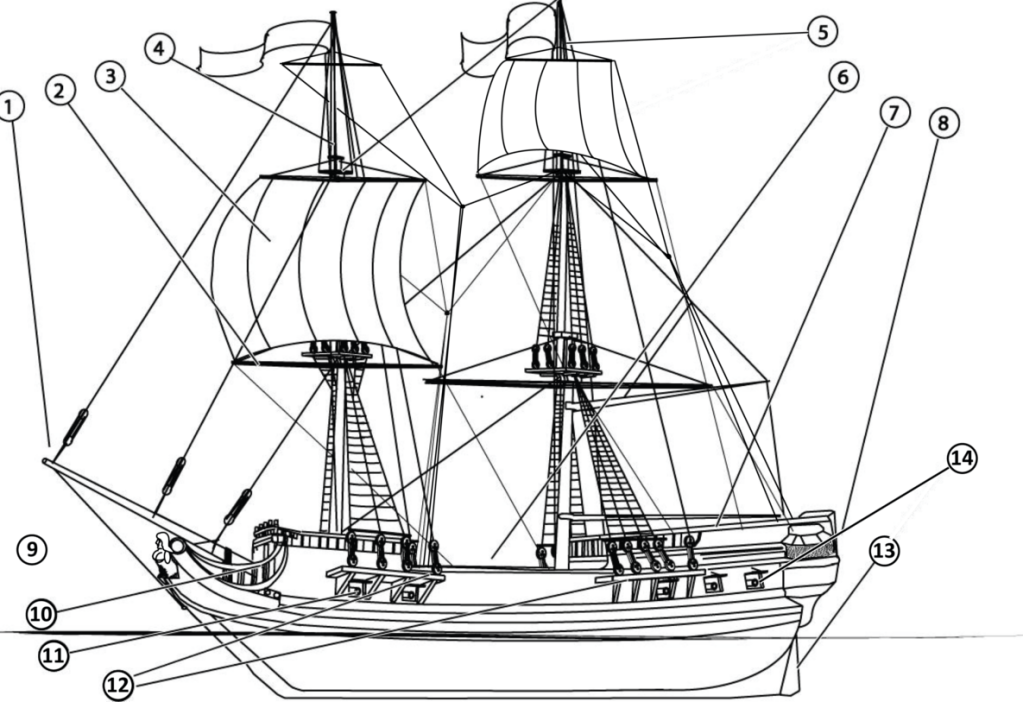
This little tiny who’s-who of ship parts shows you pretty much where I added length to her. There’s about ten feet forward of the foremast. Looking at it now, it looks kind of weird. And then there’s another twenty feet forward of the mainmast. And no guns in the waist. It’s important to the story, but looks a little odd in the light of time.
A cool thing about sailing ships, however, is that, although they were designed to general standards, no two were ever alike. And shipwrights tried just about every combination of deck length and masting plan and sail plan to come up with something efficient. So, an odd looking duck like the Kathryn B could very well have sailed the seas. Just not attractively…
Tales of the Black Falcon is part of the John D Reinhart content family. Writer, illustrator, videographer, and accidental filmmaker — find the whole story at JohnDReinhart.com.
Yoda and pirates speak the same way. This is either a remarkable coincidence, proof of extraterrestrial influence in the Caribbean, or Lawrence Kasdan being very clever.
“Judge me by my size, do you?” – Yoda
“Judge me by me size, do ye?” – Red Suarez, fictional pirate.
Eerie, isn’t it? Try this one:
“The future I cannot see” – Yoda
“The future I cannot see” – Cap’t Barbossa.
Call me crazy, but I’m seeing a definite link between the syntactically challenged English Yoda speaks and the educationally challenged middle English spoken by fictional pirates. A link, a connection, a commonality.
Try it. Take any Yoda line, swap out the word “you” with the word “ye”, and say it like Long John Silver.
“Truly wonderful the mind of a child is.”
Creepy, am I right?
So? What gives? I’ve come up with three theories:
First theory: Yoda and pirates come from the same stock. One day those ghost hunting guys who keeps discovering Chupacabra tracks for cable television are going to uncover the remains of a Yoda-like creature that crash-landed in the Caribbean some 500 years ago. “Help me, you must,” cried the sole survivor. This theory is not very likely.
Second theory: convoluted sentence structure is a byproduct of being strong with The Force. Yoda is certainly robust in that respect. And it’s not a long stretch to imagine pirates as being strong in the Dark Side. Still, Darth Vader didn’t talk like a pirate, and Kylo Ren uses pretty good grammar. Even Luke Skywalker, about whom Darth Vader said “The Force is strong in this one” – even he got subjects and verbs in the right order. Another not very likely theory.
Third theory: Lawrence Kasdan, who wrote the screenplay for The Empire Strikes Back, needed to give Yoda a quirky-yet-charming mannerism that would make him sound both familiar and alien. Clever, this dialect choice was. This would be the most likely theory.
Now, as I know you know, not all pirates talked like Yoda. Pirates mostly spoke in the dialect of their native lands – during the Golden Age of Piracy, this would have been England. And, since the greatest percentage of pirates were not men of culture and learning, they tended to use the rougher language of the streets – stab me in me vitals if that don’t be true!
If you read Treasure Island, by Robert Louis Stevenson, you’ll get a great pirate caricature in Long John Silver. But read The Black Swan, by Rafael Sabatini, and you’ll find a great mix of swashbuckling pirate and gentlemen of fortune that, while quite romantic, was probably equally accurate.
And, middle English, which was in use at the close of the Elizabethan Era, quite at the same time as the Golden Age of Piracy, was full of fun, convoluted sentence structures. This one is my current favorite: “Avoid taverns, brothels and gambling halls should I, were I you.”
Until the link between the citizens of Dagobah and Port Royal is defined, however, around Yoda my wallet should I watch. Arrgh.
Tales of the Black Falcon is part of the John D Reinhart content family. Writer, illustrator, videographer, and accidental filmmaker — find the whole story at JohnDReinhart.com.
The Disneyland song makes it sound appealing. It wasn’t. Once you turned pirate there was no going back — not to the sea, not to land, not to anything resembling a normal life.
Despite that Disneyland song that goes Yo Ho, Yo Ho, a pirate’s life would not be for most people.
A blue water sailor’s job during the Golden Age of Piracy, from around 1675 until 1715 or so, was not easy. Reefing sails, hauling braces, trimming yards – those things were massively physical tasks on the sunniest of calm days. Performing them in the teeth of a gale in the dead of night took almost superhuman resolve and tenacity.
That sailor’s life was a constant physical struggle. Things were forever damp, and his quarters were terribly cramped. Captains could be oppressive, creating what we now call a hostile work environment, with bullying and harassment and worse, the food was often bad, and with little to drink beyond rum and beer, you can see what would make a sailor’s life a misery.
Now, you would assume that your pirate, sea rover, gentleman of fortune, buccaneer, corsair, freebooter, call him what you like – a scallywag – would have had things better, wouldn’t you?
In truth, he had it worse.
All those dreadful realities that faced a common sailor were exactly the same for a common pirate. Oh, maybe the food was a little better, and the management a little less oppressive.
But the work of sailing a ship continues whether the hand on the rope belongs to a sailor or a pirate. The weather treats each with equal disdain, and the sea doesn’t care.
And once a man turns pirate, there is no going back. Wherever he goes in the world, he’s a pirate, and he can be hanged by any civilized navy.
Let’s say he goes home to visit his sister. A sailor in the pub recognizes him and tells the local magistrate. The soldiers show up and he’s marched off to jail, from there to be hanged. There’s no justice for a dirty pirate.
Let’s say he quits a’pirating, and instead becomes an honest sailorman. One day one of the crew recognizes him and tells his captain. The ship’s captain can hang him, too.
Let’s say he quits the sea – what is it he can do for a living? Beg? That happened often enough.
“I be an honest man, cap’n,” he tells the landowner. “Tending cows is what I did before I took to the sea, you understand.”
The merciful landowner hires him, and he lives in the barn and has regular, simple meals. But them folks at the pub start to whispering, and pretty soon the truth comes out and the noose goes around his neck.
Nope. Once he’s gone to the dark side, there be no turning back. That has to weigh on his soul. How could he have been so stupid?
Worse still, it was so easy to turn pirate. His own ship was taken by pirates, the crew subdued and cowed by nasty looking men with cutlasses and pistols.
“Who here will join us? Who here will take the free and easy course to riches?” says the pirate captain.
No more work aboard this barge, the sailor thinks. Goodbye, Captain Surly, and hello, freedom. Not a hard choice when you put it that way. He lowers his hands and joins the fellows with swords and guns.
“Don’t do it, Jim,” his shipmate whispers. “Them’s the devil.”
“Shut up,” one of the pirates snarls, and the shipmate shuts up. Just like that he joins the crew of the pirate ship, and the doors of civilization slam shut behind him.
Or, worse, he’s a medical man – read up in a book or perhaps had some schooling and takes care of the crew aboard a merchantman.
His ship is boarded by these grimy, barefoot men who swear and kill without remorse.
“What about you?” the pirate captain asks, his pistol pointed at the doctor. “What is it you do?”
“I, uh, am the ship’s doctor,” he replies timidly.
“You’ll be coming with us,” the captain replies. “We has need of a doctor.”
Sailmakers, coopers, doctors, blacksmiths, fellows who could navigate and steer, all were needed aboard ships that sailed under the black flag. And, like our simple pirate, they would forever be branded as sea rovers.
Piracy was a business of fear and intimidation. Unless you were the one doing the intimidation, your life could not have been very pleasant.
Money, riches, even wealth, did trickle into the hands of the common pirate, but it most often trickled right back out again. Most left this earth as poor as when they entered it.
There were exceptions, of course, and we’ll talk about those further along in our voyage.
An easy, carefree life has never been the lot of the poor sailorman, whether he was honest or sea rover.
Tales of the Black Falcon is part of the John D. Reinhart content family. Writer, illustrator, videographer, and accidental filmmaker — find the whole story at JohnDReinhart.com.
Pirates feared hanging more than death — not for the obvious reasons, but for what it meant for their souls. Blackbeard’s end was worse than he could have imagined.
Actually, this post has nothing to do with black cats, unless you are afraid of them. If you are, you probably know that your fear is prompted by superstition, and sailors in general have always been considered among the most superstitious group of people.
According to Kevin Duffus, in the The Last Days of Blackbeard, pirates had a particular fear of hanging. Of course, who wouldn’t? Although dropping from a gallows may not sound too bad, the strangling and neck snapping just can’t be much fun.
But for most pirates, hanging had a much more sinister meaning. In their superstitious minds it was far better to be killed in battle, on land or at sea. In either case, your body was buried, either in a grave (marked or unmarked, single or mass, that didn’t matter), or dumped over the side at sea. Your corporeal self was interred, and your soul could ascend to heaven.
But, when pirates were hanged, their remains were often tarred over and left to rot as a warning to other would-be pirates. As their bodies were not interred, their souls were left to wander the earth, listless and lost, for eternity.
For a man like Black Beard it was far better to die with at least twenty pistol balls in his body and more than a dozen sword wounds, than to soil himself swinging from a gibbet in front of a jeering crowd. Sadly for him, Lieutenant Robert Maynard, the Royal Navy officer responsible for his demise, decapitated the bearded giant and hung his head from the bowsprit of a ship for all to see. Poor Black Beard must still roam the wilds of North Carolina if that particular superstition be true!
It brings a new light to the particular horror of cannibalism for sailors. Bad enough that the survivors in the boat eat the corpse of their fallen shipmate, they would actually have to divvy him up, preventing his soul from getting to heaven. That’s a rum go for any seafaring soul.
Curiously enough, sailors had no fear of cats, black or otherwise. They were generally considered a part of the crew. Given their propensity for catching rats, they were probably a welcome addition.
I’m sorry if this post is a little gross – I do have a secret mission. I’m working on a plot to prove that pirates were not good people, and were very seldom sympathetic characters. Thieves, robbers, thugs, murderers. And those are the kind names. You had to be pretty smart to command a pirate ship. But the kind of smart that these men honored was deviousness and cunning – things that should never be embraced by a civilized people.
So, was you thinking of turning pirate, mate, be aware that you dunna have my blessing. And be ye wary of the noose!
Pirates wore earrings to show shipwreck survival, advertise wealth, or fund their burial. One of these theories holds up better than the others. Bob’s earrings tell the tale.
Why did pirates wear earrings?
Well, there are a quite a few theories, but also some hard facts.
This’d be a fact: was you a sailor up until around the year 1800, you would get yourself an earring to signify to them what saw you that you had survived a shipwreck. A sailor with two earrings, one in each ear, why, that fellow had survived two shipwrecks. Three earrings, three shipwrecks, and so on.
I read a theory that pirates also wore earrings as a way to show their wealth. The danglies alongside their head would tell you at a glance whether this is a successful brigand, or simply a wannabe.
While there is a little merit to this theory – who doesn’t want to advertise their success? – it runs into a bit of a problem when you think who pirates were.
And by, who pirates were, I mean who pirates ARE, because there are a great many seafaring pirates out there today. Those guys with Uzis and motorboats that attack oil tankers and freighters and cruise ships in the quiet waters all over the world – thugs with machine guns and grenades – are every bit as much a pirate as Long John Silver and Captain Jack Sparrow.
If one of these modern-day pirates were caught, say, by the Somalian Navy, they’d be hanged on the spot, and the world would cheer to be rid of the nasty fellow. As a consequence, modern day pirates keep a low profile, for fear of getting caught.
The pirates of the Caribbean were no different. Vicious, rapacious murderers, they had nothing in their minds beyond what was in it for them. Although they had some degree of brotherhood between themselves, they were viewed as a plague, and their hangings were accompanied by cheers from those that witnessed it.
So, would a pirate walk about, surrounded by thieves and cutthroats, wearing a fortune dangling from his ears? One has to wonder…
Another theory says that a pirate wore his fortune on his ears that he might get a decent burial. I be dead, says I, but use me earrings to afford me a grave, would ye?
As above, surrounded by thieves and cutthroats, one simply must wonder.
– Hey, mate,Bob just died. And he’s got a fortune in diamonds hanging from his ear.
-Don’t take them earrings, Jake. Bob wants us to use them to pay for his funeral.
-Bob’s dead, mate – he don’t need no funeral. Shove him over the side – but gimme them earrings, first.
Why did pirates wear earrings? Well, was they a sailor, it showed how many shipwrecks they survived. And, some chaps just liked the look of ’em. That’d be the true of it!
Tales of the Black Falcon is part of the John D. Reinhart content family. Writer, illustrator, videographer, and accidental filmmaker — find the whole story at JohnDReinhart.com.
Blackbeard was the most famous pirate in history and almost nothing about him is actually known. Here are three mysteries that historians still can’t solve.
If you Google the name Blackbeard, everything you read will start with something like “Blackbeard was the most famous pirate…
For all the fame he acquired in the short 18 months of his piratical career, there is almost nothing known about him. He may have been in born in Bristol, England, or in Charleston, South Carolina. He may have had a sister. He may have buried his treasure.
May, may, may. There is so much to figure out about this particular felon.
One thing we do know about him is only a surmisal, but has to be true: he was certainly charismatic. He was able to get men to follow him. Yes, there was the lure of gold. But he had to have a magnetic personality to have attracted a crew of over 300 men.
For all that, here is a trio of mysteries that flow around the fabled captain.
Mystery #1
Captain Charles Johnson, writing about pirates in 1724, referred to Blackbeard as the bloodthirstiest of pirates. He once sat at a table with his most trusted crewman Israel Hands and another fellow. As they chatted, Israel noticed that Blackbeard slowly lowered two pistols under the table, and he heard the click as Blackbeard cocked them. Fearing the worst, Israel leapt to his feet – but too late. A pistol ball smashed his knee. The second shot went wide.
“Why on Earth did ye do that?” Israel bellowed.
“If your crew don’t fear ye, they won’t respect ye,” came the laconic reply.
And yet, many historians write that Blackbeard was far more fearsome than bloodthirsty. An educated man, he doesn’t seem to have done half the nasty things history says he did.
Was he bloodthirsty, or was he crafty? And, as this is the only reference to his management style, do you suppose he was trying things out? Looking for ways to be a more effective leader?
Mystery #2
Little pieces of a book were found inside one of the cannons recovered from the wreck of Blackbeard’s prized ship, Queen Anne’s Revenge. At first they were thought to have been pieces of his personal diary. Sadly, they turned out to have been torn from a popular book of the day about another pirate’s ocean voyage to Peru.
According to the infamous Captain Johnson, Blackbeard kept a journal. The hope remains to find and decipher the exact location of the treasure he buried on his South Carolina plantation.
When asked where it buried, the pirate’s response was reported to be “that’s between me and the devil.”
By the time Blackbeard reached his final days, he was in command of over 300 buccaneers – a circumstance with which he was not happy. He was equally aware that the Royal Navy was actively hunting for him.
Do you suppose that is what prompted him to bury his spoils? Did he actually bury them? Did he keep a journal? And, does the journal tell us where the treasure is buried?
Mystery #3
He was evidently quite proud of his ship Queen Anne’s Revenge. Originally a British ship, she found her way into France and into the French slave trade. When Blackbeard took her, she was pierced for 26 cannons. That’s an old naval term for you – pierced refers to square holes cut in the ship’s side to accommodate the guns.
Typical of English pirates of the day, Blackbeard apparently packed 14 more cannons into her. The English mindset of the day was the more cannons, the better. Adding so much weight to Queen Anne’s Revenge undoubtedly affected her trim and sailing capabilities and made her several tons heavier.
Marine archaeologists have found her, in the shallows off of Beaufort, North Carolina, and have brought thousands of her pieces ashore. To date they’ve recovered 30 cannons of all shapes and sizes. That makes sense, as the pirates would have stolen the guns from the various ships they captured.
Sadly, she ran hard aground, and was abandoned.
Here’s the mystery: did he run her aground on purpose?
As before, he had over 300 pirates following him. It’s possible that the weight of that command was too much for him, and he wrecked the ship so as to disperse the crew.
Or it may have been accidental: the gentleman pirate Stede Bonnet ran his sloop Adventure aground on the same sandbar just a few yards away at the same time.
Things aboard Queen Anne’s Revenge evidently got chaotic and a little vicious. Blackbeard had already abandoned 17 of his men on a desert islet, leaving them to starve if they didn’t first die of thirst. After the grounding he took command of the Adventure and sailed her off the bar at high tide, possibly without Bonnet’s permission, leaving the greatest part of his crew to fend for themselves in the wilds of North Carolina.
But the question remains: did he run Queen Anne’s Revenge aground on purpose?
There’s none can tell for sure, but research continues every single day to solve the mysteries of this most notorious Gentleman of Fortune.
Tales of the Black Falcon is part of the John D. Reinhart content family. Writer, illustrator, videographer, and accidental filmmaker — find the whole story at JohnDReinhart.com.